

Welcome to The Wayfinder, your guide to our toxic information environment. Have a personal question about disinformation, online safety, or digital harms? Submit it to my advice column here!
G’day from Brisbane, Australia, where this morning a bin chicken (ibis) stole a potato gem (also known as a tater tot) off my plate while I ate an al fresco breakfast (sorry, not sorry, it’s summer here). Later, I delivered a keynote at the Queensland University of Technology’s Digital Media Research Center Summer School.
My speech at QUT was an anomaly for this particular trip; while I’m here, I’ll mostly be listening, not talking, collecting interviews toward a project I’ll be announcing soon.
Drawing on those conversations, in my next issue I’ll bring you my first “bright spot” dispatch: reporting about a country, person, or organization that gives us reason to hope, beginning with a a look at Australia. While I don’t agree with every decision the Australian government has made regarding online harms, it approaches technology regulation as a tricky, but not unsolvable problem. In an age where powerful governments are too frequently working in concert, rather than at odds, with the tech broligarchy, that alone is worth celebrating.
As background, today I’m republishing an edited excerpt from a 2024 paper I led for Columbia University’s Institute for Global Politics and Vital Voices. It examines global regulatory approaches to technology-facilitated gender-based violence, and uses the experience of Australia’s eSafety Commissioner, Julie Inman Grant, to illustrate the phenomenon’s effects. It also introduces some of the novel ways Australia approaches oversight of technology platforms. I hope you enjoy—and I’ll be back with more from down under on or around February 14.

ON THE MORNING OF APRIL 22, Julie Inman Grant, Australia’s eSafety commissioner, woke up for the seventh day in a row as the target of technology-facilitated gender-based violence. The abuse had begun a week earlier, on April 15, when she issued a takedown notice to the social media platform X (formerly Twitter), requiring that the platform remove a video of a violent stabbing of a bishop that had taken place at a church in Wakeley, Australia. The graphic video was in violation of both the platform’s own terms of service and Australian law. The irony that the public servant in charge of implementing Australia’s online safety laws would be targeted with the very harm she was charged with ameliorating was not lost on Inman Grant.
“She’s a goner,” read one tweet mentioning her in the early hours of that morning. “Not long before we round up these [World Economic Forum] scumbag traitors.”
In the 48 hours that followed, Inman Grant’s personal information was released publicly. The identity of her children was exposed. Tens of thousands of instances of abusive content—including rape and death threats—would be directed toward her and her family. Over 10 percent of the negative content directed at Inman Grant was gendered narratives and slurs.
Inman Grant, a technology policy professional who served as an executive at Microsoft, Twitter, and Adobe, was appointed as eSafety Commissioner of Australia in 2017 and has since served three Australian Prime Ministers. The eSafety Office was established in 2015, when the Parliament passed the Enhancing Online Safety for Children Act. Its powers were expanded in 2022 when the Online Safety Act of 2021 came into effect, covering Australia’s regulatory response to a broad array of online harms, including adult cyber abuse, cyberbullying, image-based abuse, and illegal and restricted content. On its website, the Office of the eSafety Commissioner writes: “eSafety’s purpose is to help safeguard Australians at risk of online harms and to promote safer, more positive online experiences.”
Among the eSafety’s regulatory mechanisms are transparency powers to ensure that online service providers, including social media platforms, are adhering to the country’s “Basic Online Safety Expectations.” Under this scheme, the eSafety Commissioner can issue notices “requiring online service providers to report on their compliance with the Expectations,” publish providers’ responses to such requests, and issue fines to those who are found to not be in compliance.
In 2023, Inman Grant issued two such transparency notices—relating to child sexual abuse material and online hate—to X. In both cases, she found the platform to be in non-compliance, “providing responses that were incorrect, significantly incomplete or irrelevant,” and in other cases “[failing] to provide any response to the question, such as by leaving the boxes entirely blank.” Inman Grant issued a non-compliance notice to the platform and fined it 610,500 AUD (about 412,000 USD).
According to Inman Grant, the implementation of her office’s regulatory powers angered Elon Musk, who had purchased the platform in 2022. “We used our transparency power very effectively to highlight [X’s] trust and safety issues,” she said, and Musk had a pattern of using vexatious litigation against regulators and advocacy groups to “take on any entity that was critical.”
When a video depicting a stabbing of a priest in Wakeley, Australia was uploaded to X and Meta-owned platforms in April 2024, Inman Grant issued another takedown notice to the platforms. These powers are derived from Australian law, which prohibits content depicting “acts of terrorism,” and allows her to subsequently request certain illegal content be removed from online platforms. Meta complied with the request within the hour, Inman Grant said, but X kept the content up, despite the fact that it violated the platform’s violent content policy. When the Federal Court of Australia granted an interim injunction compelling X Corp to hide the violent material, Musk began tweeting about Inman Grant on April 22nd, 2024, calling her an “unelected official,” and “eSafety Commissar,” evoking authoritarian sentiments. A further disinformation ploy to exorcize the global masses was to allege that Inman Grant wanted to censor the global Internet, though she clearly stated that she was seeking removal to protect Australians from accessing the gratuitous violence, as laid out in the Online Safety Act. These dog-whistles to his 192 million followers led to increased targeted harassment against Inman Grant.
On April 23, 2024, there were 73,694 total mentions of Inman Grant or the eSafety Commissioner’s office on X. By comparison, the office and Commissioner’s average daily mentions on X for April through December 2023 were 145. An analysis of a subset of these tweets showed that 83 percent was negative or harassing content, with more than 10 percent of that being gendered slurs or hate. These included attacks on Inman Grant’s physical appearance or adherence to beauty standards and claims she had negative characteristics often associated with women such as a lack of intelligence or aggression. Many falsely claimed Inman Grant was a part of a global censorship regime, rather than a domestic regulatory agency focused on online safety. Inman Grant was nicknamed “e-Karen.”
Some content claimed that Inman Grant was emotionally-driven in her work, and that she was seeking revenge for an unnamed slight when she had worked at Twitter eight years prior to the Wakely stabbing; still others falsely claimed that Elon Musk—who did not own Twitter when Inman Grant worked there from 2014-2016—had fired her and she had an “ax to grind.” All of these narratives—that Inman Grant was allegedly entitled, selfish, power-hungry, emotional, or seeking revenge—are frequently deployed against women in public life.
Inman Grant was labeled “Big Mother” (a gendered take on Big Brother from George Orwell’s 1984), and “left-wing Barbie,” “feminazi,” “eNazi,” or “Stasi cunt.” One tweet read: “captain tampon is a nazi dictator.” She was compared to a “terrorist” or “Hitler,” a “humanoid lizard,” and “pig.” Sexist slurs were common, targeting Inman Grant’s appearance, intellect, and gender identity. She was labeled a “dominatrix,” “eProstitute,” “eSlut,” or told to “get stuffed.” The dataset also includes common slurs such as “bitch,” “slag,” and “cunt,” as well as assertions that women are less intelligent than men or not fit for government roles. One user wrote: “Males to boot these brainwashed females out, and start governing.”
The harassment also changed Inman Grant’s life offline; Inman Grant’s family members were doxxed and users directed credible death threats at her, necessitating the involvement of the Australian Federal Police.
In early June 2024, eSafety discontinued its legal action on the Wakeley stabbing against X Corp in Australia’s Federal Court to focus on other litigation, including matters involving X. Inman Grant wrote:
I have decided to consolidate action concerning my Class 1 removal notice to X Corp in the Administrative Appeals Tribunal. After weighing multiple considerations, including litigation across multiple cases, I have considered this option likely to achieve the most positive outcome for the online safety of all Australians, especially children. As a result, I have decided to discontinue the proceedings in the Federal Court against X Corp in relation to the matter of extreme violent material depicting the real-life graphic stabbing of a religious leader at Wakeley in Sydney on 15 April, 2024.
Attacks against Inman Grant remained high even after Musk ceased actively mentioning her; her daily mentions averaged 2,585 daily between May and mid-June 2024. The harassment she faced continues today. eSafety continues taking action against X, while users attempt to continue to—at their own admission—tie up eSafety resources. This has resulted in newly-established local organizations starting a campaign to drown eSafety with Freedom of Information requests resulting in more than a 3000% increase in such requests. Sadly, the resources these campaigners are tying up exist to help Australians experiencing online abuse.
Inman Grant’s experience at the center of a harassment campaign instigated by a billionaire tech mogul demonstrates how pervasive online abuse of women can be, targeting even those charged with making the internet safer. She told my research team: “There is now a growing awareness that the way online abuse manifests against women is different.” However, she noted that the lack of regulation, particularly in the United States, is hurting women around the world. “Until the U.S. actually regulates,” she said, “the rest of the world is going to be fighting a losing battle.”
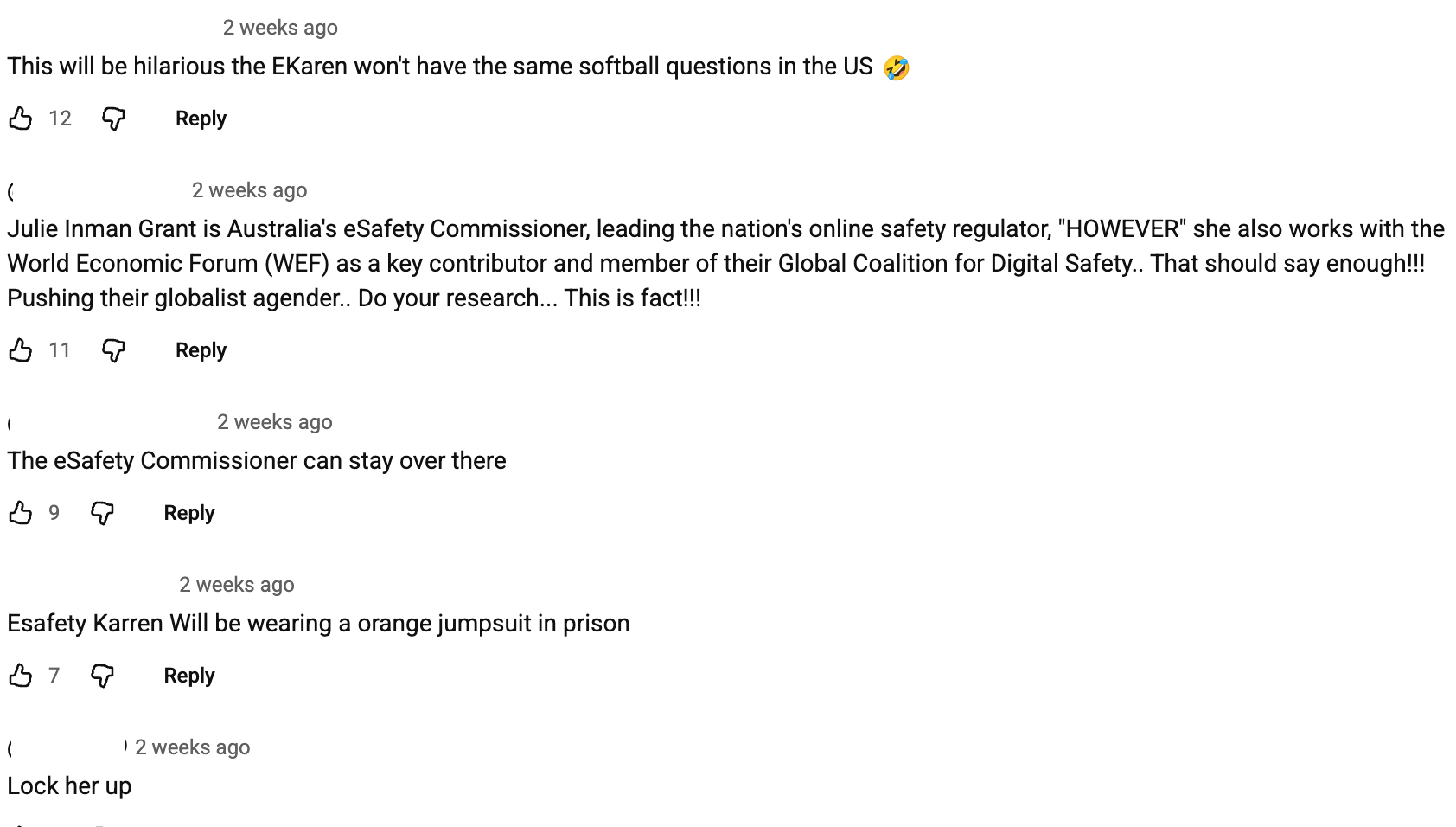
Since that paper was published, Julie Inman Grant has been targeted—like me and other advocates for a safer internet—by Republican Jim Jordan, who called her a “zealot” for doing her government-appointed job. Jordan falsely claims she is attempting to infringe on Americans’ rights to access political content and is seeking her testimony in his politically-motivated “Subcommittee on the Weaponization of the Federal Government”. The gendered narratives we saw in our 2024 research persist. Check out the comments on a SkyNews video related to Jordan’s request:
What questions do you have about Australia’s approach to online safety, including its recently-implemented restrictions on social media companies’ access to users under 16? Let me know in the comments and I’ll try to address them in my next dispatch. 🧭
This is a really useful case study of how intense online backlash can fall on people tasked with making the internet safer.
It also highlights how often that backlash has a gendered edge when women are in visible regulatory roles.
Brilliant piece. The weaponizaton of online mobs against regulators like Inman Grant really exposes how platform power operates.When I dealt with content moderation issues on a smaller scale, the harrasment patterns were oddly similar. Linking personal attacks to regulatory capture is smart bc it shows these arent random outbursts, they're calculated.