


THE IRRESPONSIBLE SPECULATION around the death of Lindsey Graham and the long, secret illness of Mitch McConnell have provided ample evidence for a fact that may upset some of you: batshit conspiracy theories are not the sole terrain of the Republican party.
As far back as 2018, when I testified in the Senate about countering foreign disinformation, I’ve always repeated a single phrase: “disinformation knows no political party.” In that context and most others, it was meant as a warning to Republicans: you may be inclined to ignore, or even welcome Russian influence campaigns when they help you, but when one day an adversary targets your party, and your candidate, you’re going to regret it. (I was proven right—see Iran’s lego propaganda.)
But another warning—one that is too infrequently acknowledged—was baked into that statement. It’s not just Republicans who are susceptible to disinformation; Democrats can and do fall victim to it, too. In How to Lose the Information War, I told the story of a group of left-wing activists who organized a Les Mis-themed flash mob on July 4, 2017, and were unknowingly collaborating with a troll from Russia’s infamous Internet Research Agency, who had helped them purchase Facebook ads to advertise the event and drive up turnout:
The $80 spent to drive show tune-loving, progressive, D.C.-area residents to the White House to protest the president in song on July 4, 2017, wasn’t a mistake; Russia has long tried to increase discord in American society.
[Disinformation] feeds on, amplifies and weaponizes our emotions, pitting us against one another. It’s not just widespread digital literacy campaigns targeted at voters and social media users we need. Politicians need to sign on as well, calling out disinformation—whether foreign or domestic, no matter which political party it opportunistically supports—as the equal-opportunity threat to democracy it is. If our elected officials and political organizations traffic in disinformation, we are doing Russia’s work for it.
Well, I am sure the Russians who work on influence operations were absolutely delighted when troves of Americans on both sides of the political spectrum immediately worked themselves up into a conspiratorial froth over the death of South Carolina Senator Lindsey Graham on Sunday. Most prominently, those claims started on the right with Laura Loomer, who floated that Russia or Iran might have orchestrated a hit on Graham:
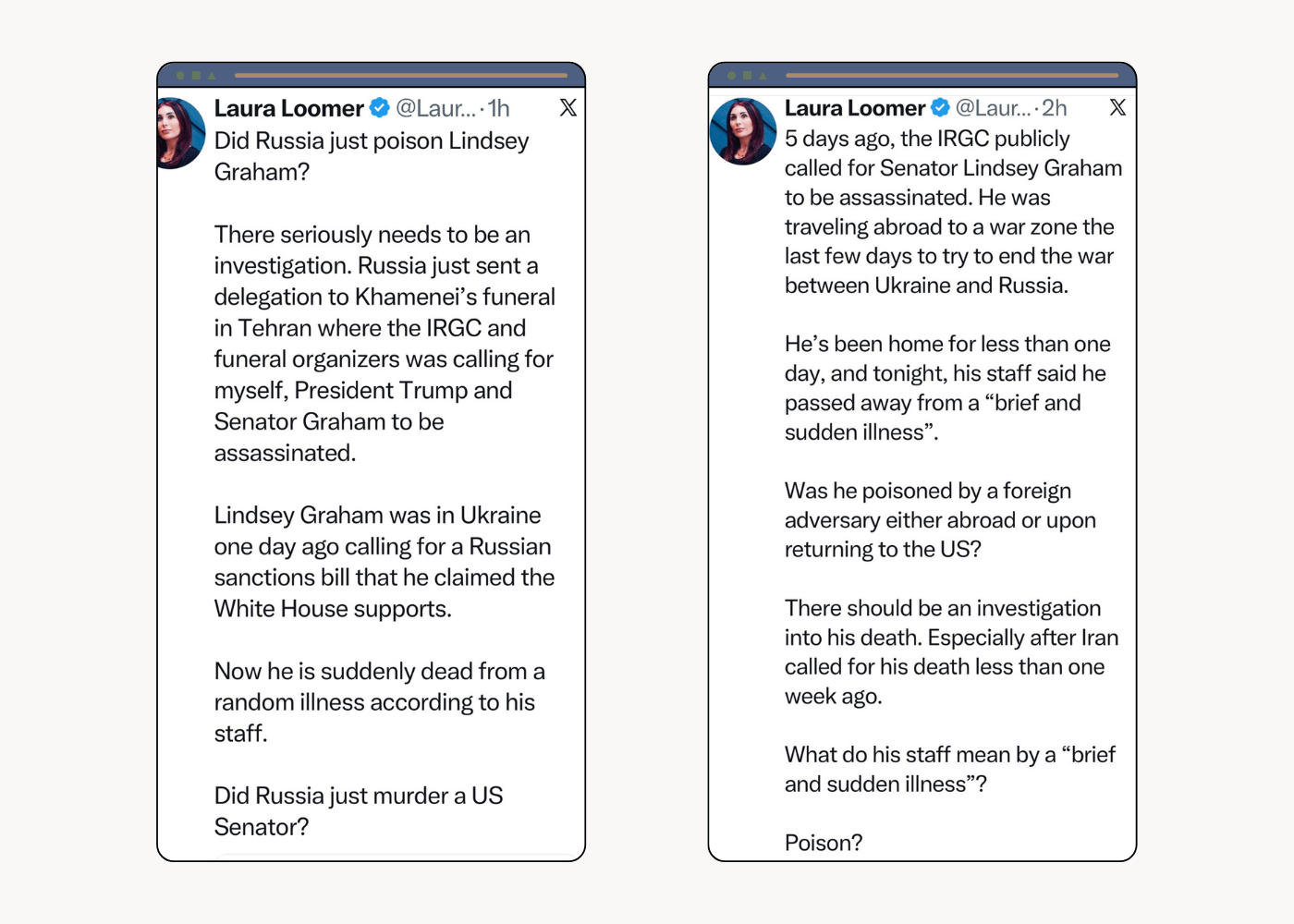
But it wasn’t very long before the conspiracies hopped the gulf between right and left like COVID at a choir practice. Progressives were telling off-color jokes about Graham in one post, and in the next expressing their deep concern that the White House was covering up his poisoning, as if poison was the sole reason a slightly-overweight 71-year-old man who just undertook an arduous journey to a war zone might suddenly drop dead.
In the evening, the DC medical examiner released a statement with their preliminary findings:
Graham suffered from an aortic dissection, in which a tear occurs in the inner layer of the main artery. This was caused by arteriosclerotic cardiovascular disease, the statement said. These tears usually occur when there is high blood pressure.
Within the same hour, Senator Mitch McConnell, who had been the focus of intense speculation and conspiracy theories after his team had suppressed information about his health since he was hospitalized on June 14, released a “proof-of-life” photo, probably in hopes of getting self-appointed investigative journalists to stop creeping around in the back alley behind his house. (Yes, that really happened, but I’m not linking the video because I don’t want to amplify behavior like that.) The photo may have been edited a bit, or else compressed—McConnell’s finger, holding the Saturday edition of the Washington Post Sports section, has a strange halo around it. The edge of the left side of his pillow looks a bit off. There are completely legitimate explanations for why this might be.
But the left-wing internet saw only conspiracy. Almost every single post in my Threads feed on Sunday night was a would-be sleuth sharing their smoking gun: AI had told them the photo was actually from 2023! Or AI-generated! Or legitimate, but enhanced, so the Senator’s seemed younger and wrinkle-free! (Deepfake detection expert Hany Farid posted on Monday that he can find no evidence the photo is AI-generated.)
This all made me pretty distraught. A lot of the prominent folks who were fanning the flames of these conspiracy theories should have known better. The general population was primed for this, between a Senate office that hadn’t communicated in a month and a strong and understandable degree of distrust toward anything anyone allied with the Trump administration said or did. And everyone was using technology that was appealing to their worst instincts—they wanted answers, they wanted the answers to make them feel smart or righteous, and they wanted them now.

As the conspiracies were spiraling out of control, I posted the following two exhortations to reason on my social platforms:
In response, a lot of angry people told me I was being a scold, that I was admonishing them for asking questions, or that I was insane because the McConnell photo was—to their very expert eyes—so obviously manipulated.
I want to be clear: I’m not telling anyone that they should stop asking questions or holding the Trump administration to account. But it’s important to recognize that the behavior we saw on Sunday night—breathless speculation entirely devoid of evidence—isn’t what accountability looks like, and it isn’t accomplishing much besides making social media platforms money. It was incentivized by social media platforms that want to keep us scrolling and seething, generating revenue through advertisements. They created algorithms that reward enragement with engagement, and creators—who rely on social media to pay their bills—know what it takes to get and maintain attention.
What I’m asking of you, and of everyone who aspires to return to a shared reality, is actually a lot more difficult: to actively work against the way we’ve been conditioned by unscrupulous politicians, influencers, and the social media platforms that made them. To actively work against human nature. To practice patience.
These are four maxims that I hope will help you in that mission. I’d also encourage you to check out @ Michael Caulfield’s SIFT Method and The News Literacy Project’s Breaking News Checklist.
If the content you’re consuming is salacious, shocking, enraging, or otherwise making you emotional, someone may be manipulating you. We know platforms amplify emotionally-charged content. We know users—especially those who monetize their content—know this. Breaking news events are ripe for engagement bait. If the content were on the front page of the National Enquirer at the supermarket—or better yet, if you saw it on Laura Loomer’s feed—would you believe it?
If news is fresh, details will be scarce. News outlets and experts are doing due diligence to verify accounts from human sources and confirm video and photos are authentic. None of that happens instantaneously. For those that make claims with certainty in the hours after news breaks, see #1.
AI hallucinates. It can’t do what you’re asking. It probably can’t answer your questions about breaking news, and it definitely can’t accurately verify the provenance of a photo or video. Treat it like an intern that favors speed over accuracy or a student who definitely hasn’t done the reading but keeps answering the teacher’s questions anyway.
The simplest explanation is probably the right one. Yes, even now. An aging man had heart problems. A frail man who probably shouldn’t be a Senator anymore did a poor job communicating about his frailty. There are many evil things happening, but they are still outnumbered by plainly stupid choices and unfortunate facts of life.
If you’re a chronically-online engaged citizen who wants to keep up with the news and keep the pressure on the government, you can be a responsible information consumer in a world of AI slop, but you need to start by slowing down and recognizing that you can’t know everything immediately. Your advocacy and your rage is better served when it is grounded in reality. 🧭
Easier to offer an ill-informed hot take and enjoy the hit of feeling righteous or justified or better than or whatever else than to allow a situation to unfold.