

Hello, and welcome to The Wayfinder, your guide through a polluted information environment. In addition to analysis like this, I run “Ask Nina,” my digital safety and resilience advice column. Have a question about trolls, disinformation, or the weird thing Uncle Bob sent you on TikTok? Ask me here.
Paid supporters get access to my brand-new 10-Day Online Safety Tune-Up based on the tactics and tools I used to hold my digital ground against MAGA trolls and Russian hackers. Early reviews called it “invaluable” and “life-saving.” Become a paid supporter and get yours today!

One of the stranger features of the last four years of my life is that the conspiracy theories about me are so numerous I’ve forgotten some of them. Strangers online purport to know my secrets. They falsely claim I attended Chelsea Clinton’s wedding (no), that I was arrested by a Special Forces team outside of a defunct bar (no), that I was a “clandestine operative in Eastern Europe” (no).
This week, while trawling the State Department’s Freedom of Information Act (FOIA) Archives for a research project, I was reminded of another conspiracy theory about me that burned short and bright in 2024: people believed that while I was getting a resource-poor non-profit up and running and mothering a two-year-old, I was somehow responsible for or involved in the arrest of Telegram CEO Pavel Durov. They believed this so fervently they submitted at least 23 pages of FOIA requests—totaling at least six dozen1— to the State Department seeking my (nonexistent) communications with the Department about Durov or to the French Embassy.
This episode, despite its absurdity, highlights something much more serious: the many ways that democracy’s openness is weaponized to punish enemies and undermine the basic functions of government.
What is the Freedom of Information Act?
Before we get into the meat of this saga, a quick primer on FOIA.
The Freedom of Information Act is a federal law enacted in 1967 and strengthened after the Watergate scandal that gives anyone the right to request access to records held by executive branch agencies of the U.S. government (the courts and Congress are exempted from the Act). Agencies are supposed to disclose requested records unless those records fall into one of nine narrow exemptions for things like national security, law enforcement, trade secrets, or clearly unwarranted invasions of personal privacy. Though all administrations work these exceptions to avoid embarrassing or scandalous disclosures, FOIA continues to be a workhorse of democratic accountability that watchdogs, researchers, and regular citizens use to understand or expose government decisionmaking.2
FOIA is how we learned about the CIA’s post‑9/11 torture program, government surveillance of Black Lives Matter organizers, and emails showing how officials in Flint handled the city’s water crisis.
A Study in Administrative Burdens
FOIA, for all its nobility, is also a system that can be gamed. Increasingly, bad‑faith actors are learning to weaponize the very transparency rules meant to keep the public “in the know.”
Over the past few years, we’ve seen powerful, often well-moneyed interests organizing their supporters to use the FOIA system to impose administrative burdens. Ahead of the 2022 midterms, for example, The Washington Post reported that local election administrators had been inundated with state-level public records requests:
In nearly two dozen states and scores of counties, election officials are fielding what many describe as an unprecedented wave of public records requests in the final weeks of summer, one they say may be intended to hinder their work and weaken an already strained system. The avalanche of sometimes identically worded requests has forced some to dedicate days to the process of responding even as they scurry to finalize polling locations, mail out absentee ballots and prepare for early voting in October, officials said. [...]
The use of mass records requests by the former president’s supporters effectively weaponizes laws aimed at promoting principles of a democratic system — that the government should be transparent and accountable. Public records requests are a key feature of that system, used by regular citizens, journalists and others. In interviews, officials emphasized that they are trying to follow the law and fulfill the requests, but they also believe the system is being abused.
This is an administrative burden, one of a few key tools that autocrats and their supporters use to keep their adversaries down and out. If autocrats can’t sue you, throw you in jail, or frighten you into abandoning your work, they bury you in paperwork, forcing you to invest limited resources in dealing with it. The right-wing ecosystem has used it against the government, but it can also be used against other public institutions.
In the field of disinformation research, publicly-funded institutions like universities have been targeted with frivolous and burdensome requests. I’ve heard over and over again that researchers and public organizations have had to hire extra staff to deal with them. Sometimes, the cost is too simply too great for them to bear. Institutions would sooner shut down entire lines of research inquiry and attempt to insulate themselves from such bad-faith administrative attacks than continue to bleed resources on responding to them.

The Inescapable Gravity of the Conspiracy Vortex
That brings us to the false allegations about my alleged involvement in Pavel Durov’s arrest that gave rise to dozens of State Department FOIA requests.
In the days after Durov’s arrest, a Qanon conspiracy theorist and professional election denier (who I will not identify, as I’d prefer not to drive traffic to their accounts) posted a late night rant on right-wing video platform Rumble. They then cross-posted it to their other social media accounts, including their Telegram channel, which today boasts over 40 thousand followers. The unhinged tirade repeated the core lie about me—that my job in the Biden Administration was to censor my fellow Americans (no)—and took it a few steps further. According to this conspiracy theorist, I was at the “center” of Durov’s arrest in France, and Durov was arrested because he wasn’t “silencing speech” as I allegedly wanted.
(A reminder, for those that may have forgotten: the United States had nothing to do with Pavel Durov’s arrest, which occurred in France and was conducted by French authorities, and the charges against him were not about misinformation, speech, or “censorship.” The French Government indicted Durov “on multiple charges including spreading child abuse images”—you know, that thing Qanon claims to care about!—“[and] drug trafficking” and cited Telegram’s “almost total failure to respond to judicial requests” as it was investigating crimes on the platform.)
The conspiracy theorist then encouraged their followers to send FOIA requests to the State Department that requested my communications about Telegram, Pavel Durov, or with the French Government. This is called “brigading:” coordinated, pre-planned, mass online activity that often gives the guise of grassroots support or dissent about a given topic. The influencer guaranteed their followers that I was behind Durov’s arrest, and that they would be rewarded with troves of my communications if they simply used their rights (and a little help from ChatGPT or Grok) to request them.
And request them they did. Beginning August 25, the conspiracy theorist’s followers sent dozens of similar requests to the State Department. It’s one of the cleanest examples I have that people are willing to take real-world action based on online lies about me.
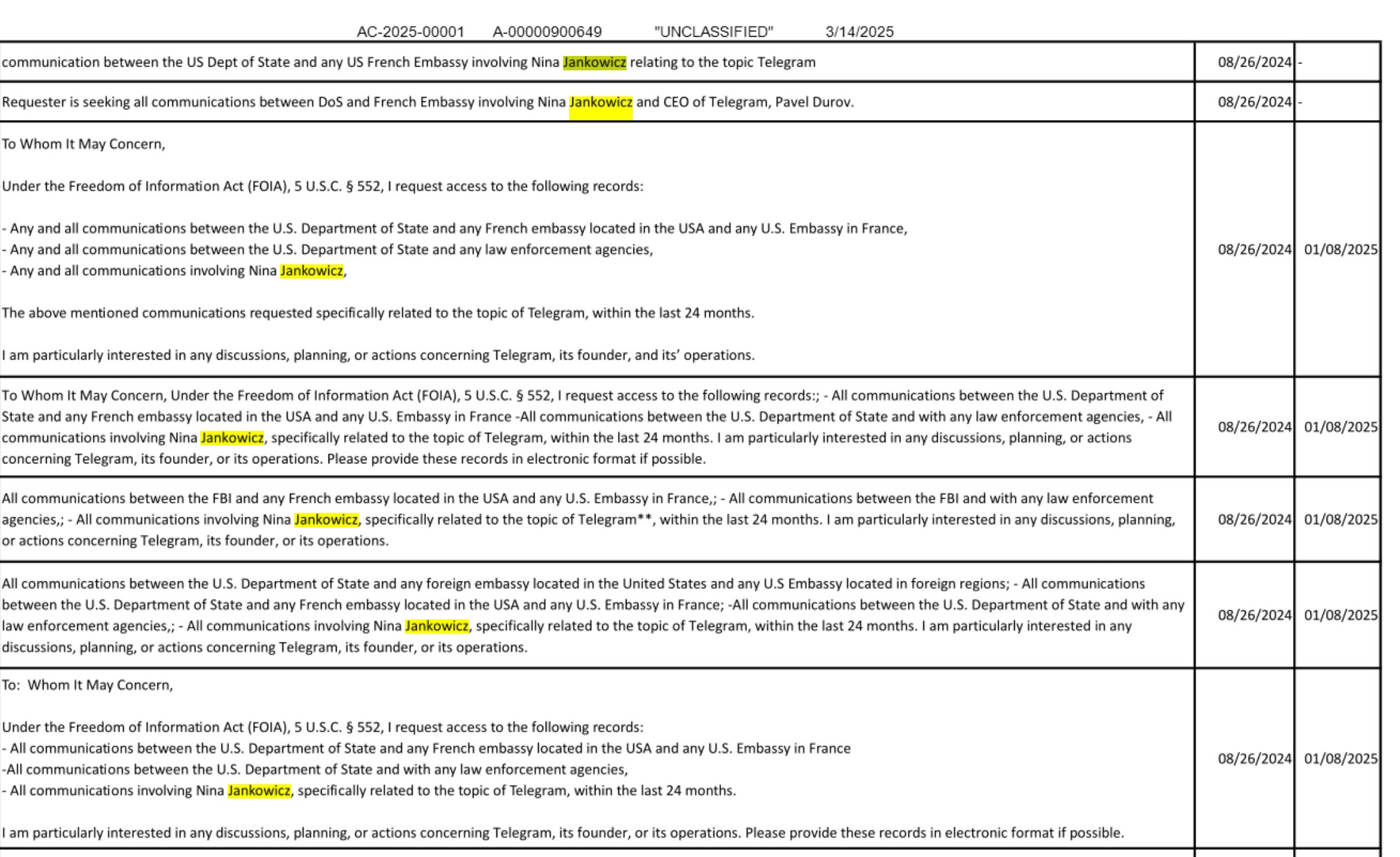
Needless to say, they didn’t uncover evidence of collusion. They just forced some poor civil servants in the State Department FOIA office to waste their time sending dozens of replies stating no such records existed. They were guaranteed a treasure trove. When they received a goose egg, I doubt they noticed the crack in the mirror of illusion that had captivated them for so long. It’s more likely they interpreted the lack of records as yet another conspiracy, yet more evidence of my alleged crimes. When you’re convinced that everyone is lying to you, the gravity of the conspiracy vortex is practically inescapable.
The saddest part of the story is that though these individuals set out attempting to inflict harm on me, all they did was waste resources: their time, the government’s, and the taxpayer dollars that funded this escapade. This is part of a broader pattern. It wasn’t just local election officials or the State Department slammed with such requests. The Columbia Journalism Review reports that automated systems funded by right-wing money have lead federal FOIA requests to “nearly double” in the past five years. “In that same time period, the number of FOIA officers at the federal level hasn’t budged.”
Defector’s Diana Moskowitz argued:
Faithful mimicry should not to be confused with actual honesty. People who regularly work with public records understand why we have them—because of public pressure on institutions for transparency—and how gleefully those in power (aka state legislators) are about seizing excuses to take that right away. [...] Requesting a large and unwieldy...
...or, say, nonexistent!...
...data set from a local clerk for the 50th time does nothing to address that. What these requestors don’t seem to realize, or perhaps care about, is that they are not only making the lives of election workers much more difficult, but the most likely outcome of their demands is this: Calls for new laws limiting public records requests, which would not benefit the public in the least.
FOIA and other public records laws are critical to citizens’ ability to hold the government to account. I’m glad they exist. (Heck, I’m even glad that my DHS emails have been released under FOIA, because if the requestors actually read them, maybe they would finally realize they were taken in by lies!3 A girl can dream.) I struggle to identify ways public records could even be amended that wouldn’t block or slow down legitimate requests.
That leaves me where I often end up when dealing with issues of truth and trust in modern democracies: building resilience to bullshit. For dozens of strangers to be so convinced, based on one charlatan’s late-night Rumble outburst, that I was involved in another sovereign nation’s arrest of a tech CEO, they had to be pretty far down the rabbit hole. That doesn’t happen overnight. It’s the result of years of feeling disenfranchised, followed by years of powerful or amoral people capitalizing on that disenfranchisement for power and for profit. (The conspiracy theorist who started this saga has multiple paywalled feeds for her subscribers, of course.) We need to help people avoid the mendacious manipulation that is a feature of the 21st century internet—and, when people who safeguard the truth return to government, they’ll need to work hard to earn all Americans’ trust.
It’s not a satisfying or clean answer, I know, but it’s one that endures. As Thomas Jefferson wrote in 1820 (a quotation I’ve cited in many briefings and papers over the last 10 years):
I know no safe depository of the ultimate powers of society but the people themselves; and if we think them not enlightened enough to exercise their control with a wholesome discretion, the remedy is not to take it from them, but to inform their discretion by education.
Perhaps foolishly, I still agree. It’s part of why this newsletter exists—to help inform your discretion in an increasingly complex, polluted internet. And until we’re all retrofitted with AI-powered chips in our brains, I think it’s a goal worth pursuing. 🧭

The total number of requests may well be more, but a further few dozen requests have been redacted because they contain personal information, likely the requester’s email, phone number, or address.
If you want to learn more about FOIA, including how to file and track these requests, as is your right, check out 404Media’s FOIA Forum, where the independent media outlet discusses their philosophy behind the requests and shares some tips. (These trainings are for their subscribers only; I’ve subscribed to 404 for a few years and find it to be well worth the cost!)
Many of the requestors issued chest-beating press releases as they submitted their FOIA requests pledging to uncover non-existent evidence of government censorship. Those that issued follow-ups complained about the redactions. Unsurprisingly, no one issued an “oops, this was a nothingburger” release. They never intended to; the accusation and assumption of guilt is more important than the pesky facts.