

Welcome to The Wayfinder, your guide to our toxic information environment. Have a personal question about disinformation, online safety, or digital harms? Submit it to my advice column here!

Last weekend I went to Australia’s Blue Mountains, where I met a very persistent wild cockatoo who made me think about the importance of rules in democracies.
I was staying in a historic hotel built in the late 1800s. It had beautiful stained glass windows, plush carpeting, an old-timey elevator that was clearly haunted, and no air conditioning amid Australia’s record-breaking heat. It was, in a word, authentic. When I returned from a hike on Sunday, my room was stuffy—unsurprising for Australia in the summer—so I opened my windows. To my dumb American dismay, they only opened a few inches before some sort of hotel-imposed safety lock kicked in.
“Surely in a hotel with no A/C they should be more worried about people sweating to death than flinging themselves out windows,” I thought to myself, annoyed, while I cranked up the fan and lay down for a snooze. I was, of course, forgetting about the winged Australian creatures that might make their way through the window if it were fully open: fruit bats (far from a cute plot point on Bluey, they are basically flying puppies) and large birds.
A few minutes later, I woke up to a thunk and turned to see this sulphur-crested cockatoo staring at me:
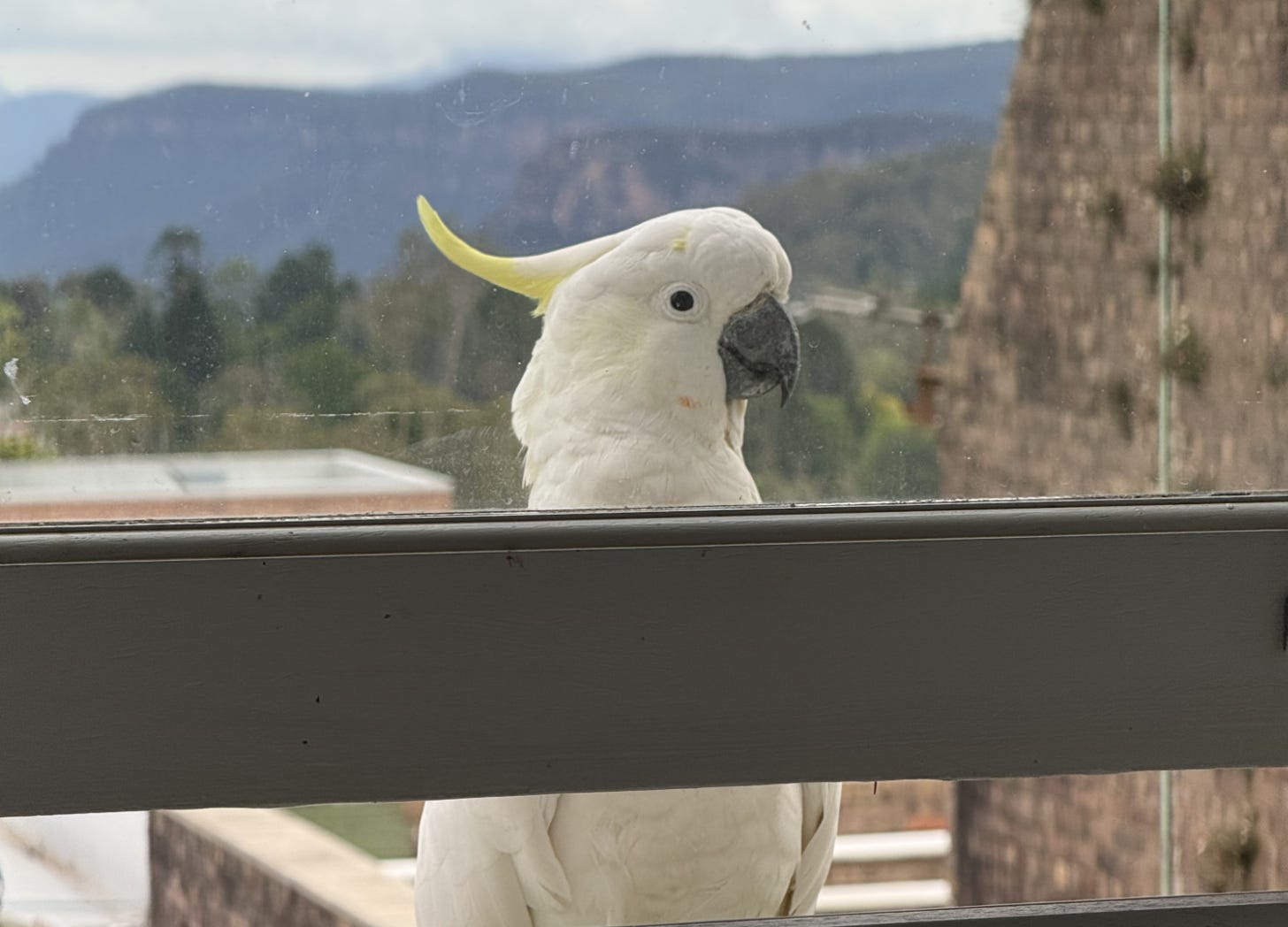
Let me be clear: sulphur crested cockatoos are BIG birds. Their wingspan can top a meter. The first time one swooped over my head last week, I ducked; I thought a hawk was divebombing me, because THE ONLY BIRDS THAT BIG IN AMERICA ARE HAWKS. And here was one such large bird—who had clearly been fed by delighted Blue Mountains tourists for years—attempting to break into my room.
As he stuck his curious little head through the window, trying to ascertain whether he could squeeze through, I was very thankful the window didn’t open all the way; otherwise, I’d have had a sulphur-crested cockatoo as an uninvited roommate. (I prefer to admire wiley, naughty birds from a distance of at least a few feet).
“Hang on, Nina, how does this have anything to do with democracy?!” you ask. “I subscribed to this newsletter to understand our tech environment, not to read about your encounters with Australian animalia (however charming)!”
Calm the farm, folks (Australian for “chill out”).
Just as most people wouldn’t want a sulphur-crested cockatoo in their hotel room, they do not want to be poisoned by the food they eat, or the air they breathe. They want to get in a car, train, or plane, and have a reasonable expectation of leaving those vehicles alive. They want their children to use the internet without being groomed or trafficked or made to believe they need to starve themselves or commit acts of terror. They want to keep their hard-earned money and avoid being scammed. And some portion of people throughout the world believe that it is the duty and purpose of governments to protect them from those things.
The hotel knows that clever cockatoos frequent its garden and prey on tourists. Therefore, it only allows guests to open their windows to a smaller-than-cockatoo-sized sliver.
The Australian government has seen its children preyed upon online. It has seen adults abused and driven to suicide for harassment and threats they have received. So the Australian government passed the world’s first laws protecting people online—and they work.
As I’ve spoken to policymakers here, I’ve been struck by this fundamental pact between the Australian government and its citizens. Protecting people—taking care of them— is seen as the government’s core responsibility. And as one former cabinet minister from the center-right liberal party—not a so-called “left-wing lunatic!”—told me, it’s not just a responsibility, it’s what citizens expect. When something goes wrong, Australians “want the government to do something about it.”
At a moment when the U.S. government is actively endangering—not protecting—ordinary citizens, that feels like a radical concept. The Trump Administration kills protestors and jails innocent people of color while protecting its own: the powerful men who have sexually abused girls, the tech companies that profit from polarization, the doctors who peddle snake oil cures, and the business tycoons destroying our planet. Worse, they’ve convinced their supporters that safeguarding the reputations and fortunes of these criminals is somehow helping the little guy, that wanting protection from your government is somehow weak or emasculating. You don’t need the government to help you—you can protect yourself. You’re the good guy with the gun—until legally carrying that gun gets you killed by an unaccountable paramilitary force that is flouting our democratic society’s remaining rules.
Maybe I’m extending the metaphor too far, but the second year of the Trump administration feels less like hotel management allowing cunning cockatoos to prey upon unsuspecting Americans and more like the cockatoos are running the government, gleefully ripping off bird spikes and shitting on the people on the pavement.
When you demonize rules, when you deliberately break the social contract, you aren’t championing freedom, you’re capitalizing on chaos—and spreading it. Look at the ongoing measles outbreak in the United States; mocking vaccine mandates as government overreach has led to the deaths of three people in 2025 and over 800 people infected in 2026 alone.
To be clear, I’m not arguing for a Russian or Singaporean style of government. I don’t think we should fine people for chewing gum or neglecting to flush a public toilet. But after two weeks in a country where the government is trying hard to protect its people and its land while preserving personal freedoms—sometimes overstepping, sometimes not quite meeting the mark—I feel an immense sense of loss for the United States. Our basic understanding of the relationship between a people and its government have been so thoroughly perverted that most Americans now believe Ronald Reagan’s famous line: “the nine most terrifying words in the English language are: I’m from the government, and I’m here to help.” That’s not a good thing.
We’ve not only let the cockatoo into our room, we’ve invited a whole flock in, and are headed toward a Hitchcock-style scene of horror.