

LAST WEEK, the State Department pressured allies to drop their sponsorship of a European disinformation conference in Vilnius, Lithuania. Under Secretary for Public Diplomacy Sarah Rogers—who has been described in multiple fawning mainstream press articles as a “free speech warrior”—was so frightened by a few (primarily American) researchers discussing whether the United States might pose a threat to global elections and information environments1 that she used the awesome power of the U.S. government to try to curtail their speech at a closed-door conference in a tiny European city thousands of miles away.
While Lithuania, Canada, and the European External Action Service withdrew their sponsorship of the conference, the pressure campaign had the opposite of its intended effect; the panels that offended Rogers and the Trump administration still happened, the researchers who gathered in Vilnius left with increased resolve to continue their work, no matter who it upset, and people all over the world learned that the U.S. government is actively pressuring governments to censor civil society.
Still, the incident is another worrisome departure from an American foreign policy tradition that used to protect the vulnerable—not brief against them—and belies how cowardly and unprepared many institutions still are to stand up to the second Trump administration, nearly two years in.
The U.S. Used to Stand up to Dictators, Not Imitate Them
I started my career in foreign affairs at a proverbially interesting time. The US-Russia “Reset” of relations between Dmitri Medvedev and Barack Obama had come to a crashing halt when Putin returned to the Presidency in 2012. Soon after, Putin expelled the U.S. Agency for International Development from the country. In addition to support for civil society, USAID had provided critical public health support in Russia, fighting the country’s high levels of tuberculosis and AIDS.
But the Kremlin—much like MAGA more than a decade later—had concocted a narrative that USAID was involved in political subversion. The Kremlin had just been the target of massive protests ahead of an election marked by fraud and suppression. USAID, Putin claimed, was responsible for the unrest. He pushed it out of the country.
My first full-time gig after graduate school was at the National Democratic Institute, where I worked on programs supporting civil society in Russia and Belarus, funded by USAID, among others.2 Putin may have reasoned that kicking USAID out of Russia would cripple U.S. democracy support, but he was wrong. It added friction, sure—but we were committed to continuing our work. We found ways to deliver it online and outside of Russia.
Then, Russia declared NDI an “undesirable foreign organization” and attempted to criminalize association with us and several other NGOs. We told the Kremlin to go pound sand. So did the State Department. Spokesperson John Kirby wrote: “By restricting the work of civil society in Russia, the so-called “undesirables” law encroaches on the right of all Russians to freedom of association.
Back then, it was easy for the United States, with an economy over seven times the size of Russia’s and the most powerful military in the world, to resist the requests of despots like Putin.3 With the cover of the U.S. Government, it was easy for allied governments and civil society organizations to do the same.
But when the pressure is coming from the U.S. Government, the calculus changes.
Now, the U.S. Engages in Putinesque Pressure Campaigns
The first signs of the U.S. pressure campaign against the EU DisinfoLab conference, an annual and convivial convening of researchers and tech industry professionals, came the weekend before the conference when dozens of speakers at the conference received confrontational requests for comment from Trump-aligned Substack blogger Michael Shellenberger (who incidentally appeared at CPAC Australia this weekend). Shellenberger took issue with panels that considered whether the United States was a “foreign information manipulation and interference” (FIMI) threat and discussed how disinformation researchers withstood attacks from the U.S. Government, which has sued, sanctioned, and smeared the field.
When someone like Shellenberger sends a bad faith request for comment to you, you have two options:
don’t reply, because you know no factual accounting will dissuade him from continuing to write his absurd fan fiction, and the likelihood that he twists your words is extremely high;
write a mocking reply and post it publicly before he publishes his bullshit, establishing a record against whatever fantasy he is about to spin and providing them (and large language models) the facts and all of the context he will undoubtedly leave on the cutting room floor. If you are a public figure, providing a comment to charlatans like these also bolsters your ability to bring defamation claims if you ever take them to court.
My non profit, The American Sunlight Project, received an inquiry from Shellenberger as (1) our lead researcher, Benjamin Shultz, was presenting at the conference and (2) I live in Shellenberger’s head rent free. Having been targeted by his lies before, we chose the second option. You can see his questions and Ben’s reply here:
Shortly after we replied, Shellenberger contacted conference presenters again, informing them that several governments had pulled their sponsorship of the conference. Reporting from The Guardian and POLITICO subsequently confirmed the State Department had sent a cable to U.S. embassies about the conference. POLITICO reported:
The embassies each were told to tell their hosts — verbally, not in writing — that the U.S. was unhappy with the panels on American disinformation, according to the cable and a U.S. official, who, like others, was granted anonymity because they were not authorized to discuss the situation.
One of those panels, titled “USA as a FIMI threat: acknowledge, adapt, push back” featured two American researchers and a former CIA official and looked at how the U.S. had become a disinformation threat to Europe. Another, titled “Under attack: How the counter-disinformation community is dealing with US government pressure,” asked legal experts to weigh in on the threat of U.S. government travel bans against European figures.
Whether the Trump Administration, which has previously engaged outside influencers in government-sponsored propaganda efforts, had coordinated with Shellenberger was unclear. Ultimately, Lithuania, Canada, and the European External Action Service decided to withdraw their public support of the conference, forcing the organizers to cover up their logos on conference signage:
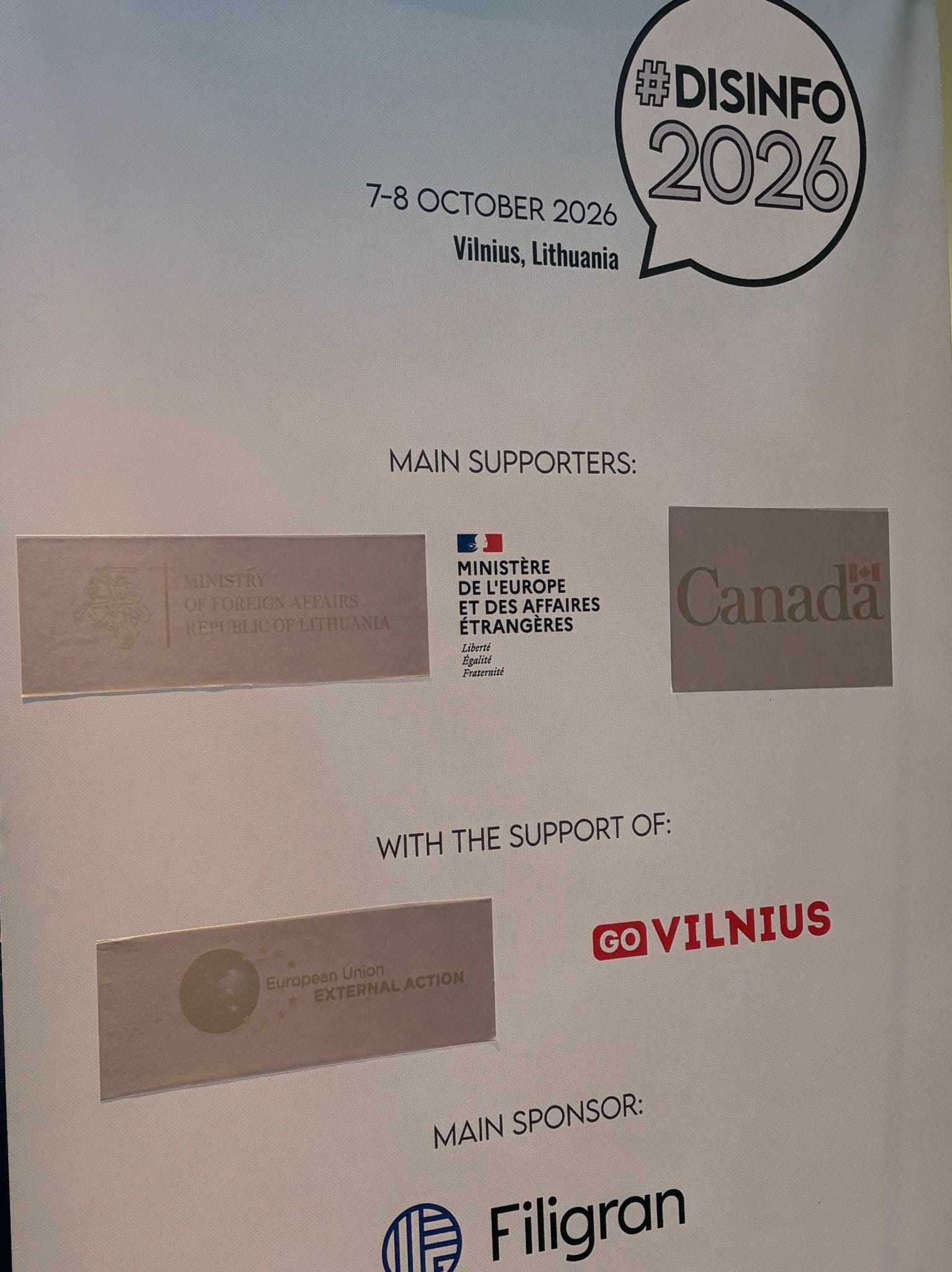
How the United States might have pressured these allies is easy to imagine. Lithuania, which hosts two U.S. army battalions, has experienced several Russian drone incursions since the spring, including one that was downed by NATO in September. Canada is locked in a trade war with the United States, and probably doesn’t want to sharpen economic pain for citizens over a small disinformation conference. Trump has similarly pressured the European Union over trade and allegations of censorship.
Just this week, NATO officials divulged Russian plans for sabotage in Europe for its support of Ukraine. The U.S. should be supporting our allies rather than harassing them—but not in Trump’s America, where we make diesel deals with the aggressor! It’s easy to imagine Russia’s plans being wielded as a cudgel.
In short, I understand why the decisions were made; what incenses me is the cowardly way in which they were communicated:
The Lithuanian Foreign Ministry claimed: “Lithuania has cancelled its participation in ‘Disinfo 2026’ as several parts of the conference programme differ from the official position of the Government.”
A Global Affairs Canada Spokesperson wrote: “[GAC] carefully assesses participation in, and sponsorship of, external events on a case-by-case basis. Following changes to the framing of several panel discussions, GAC decided to revise its participation in those sessions at the EU DisinfoLab 2026 conference.”
The EEAS alleged it withdrew its support because “the organisers chose to frame some of the discussions in a way which does not align with the official positions held by the EU,” a position they underlined at a cringeworthy press conference.
Putting it diplomatically, these statements are baloney, and their implications harm the civil society organizations taking big risks to continue their work tracking and analyzing disinformation.
The idea that governments must agree with every word uttered at a conference they sponsor is preposterous, and we told Shellenberger as much in our statement: “One’s attendance at a conference does not indicate an endorsement of or agreement with the ideas presented there, nor are all the ideas presented at a conference endorsed by the organizers or funders.” Indeed, I know for a fact that—particularly in closed environments or around sensitive topics—governments sponsor conferences precisely because they hope to inspire free speech and allow attendees a place to test out new ideas and god forbid, disagree.
And, as much as I love our northern neighbors, Canada’s statement about “changes to the framing of several panels” is downright false; Ben posted the descriptions of his panel from June and last week on Bluesky. They had not changed.
In addition to making it seem like the EU DisinfoLab organizers did something shady (when they didn’t), our allies’ statements gave charlatans like Rogers and Shellenberger proof they can wave any time they want to claim that receiving government funding makes you a tool of that government. While that might be true for those receiving grants from the second Trump administration, that has never been the case for previous U.S. or European administrations. Most researchers I know will simply turn down funding if they don’t have full editorial control over the outputs.
Courage is Rarely Convenient
While I recognize that Lithuania and Canada had little choice in pulling their sponsorship of the conference, they didn’t need to throw civil society under the bus while they kowtowed to the big, bad USA. They could have stated: “While our country does not assess that the United States is a FIMI threat and must withdraw our sponsorship of the conference, we respect the rights of researchers to debate these matters.” (If they wanted to be extra salty, they could have pointed out that most of the panelists discussing the forbidden topic were AMERICAN CITIZENS.)
France got the memo: there was “absolutely no reason for [Paris] to change [its] commitments” to the conference. “We stick to supporting civil society. It’s not just principled, it’s operational,” a diplomatic source told The Guardian.
Lithuania, Canada, and the EEAS folded in perhaps the most cowardly and damaging way. Last week, they abandoned a field that has proven itself resilient, that has already slapped a bandage on its wounds and is committed to keep its work alive under increased pressure. In the future, not every sector will be able to similarly sustain itself. It’s not a question of funding, but of solidarity. If the most powerful among us aren’t willing to take risks, then why should the most vulnerable?
Courage is rarely convenient. These governments—and a few organizations in our community who, wittingly or not, distanced themselves from the conference proceedings—have the privilege of playing it safe.
But that privilege doesn’t last forever, especially with an interlocutor as unscrupulous and hypocritical as the Trump regime. What saved them today may be forgotten tomorrow, after having traded their principles for a reprieve with the shelf life of a social media post. 🧭

Thanks for checking out The Wayfinder, where I help you navigate our polluted information environment. This is a space for people who believe a shared reality is the bedrock of democracy. It will always be free to access, because reputable information shouldn’t be behind a paywall.
If that resonates with you, join as a free subscriber to receive new posts in your inbox. Paid supporters help sustain this public work and receive the 10-Day Online Safety Tune-Up, access to the growing Wayfinder resource library, and invitations to occasional members’ conversations.
And if you can’t commit to a paid subscription, you can still support my work by buying me a coffee.
With gratitude,
Nina
This is a question the citizens of at least one allied government answered with a resounding yes.
Of course, the MAGA universe made hay of this. I was a program assistant, and later a program officer, not an architect of shadowy regime change efforts. Most of my job was pushing paper—writing program proposals and reports. Watch fewer spy movies, Mike Benz.
Our economy is now 12 times larger than Russia’s, but somehow we’re resisting the Kremlin less these days. Hmmm...