

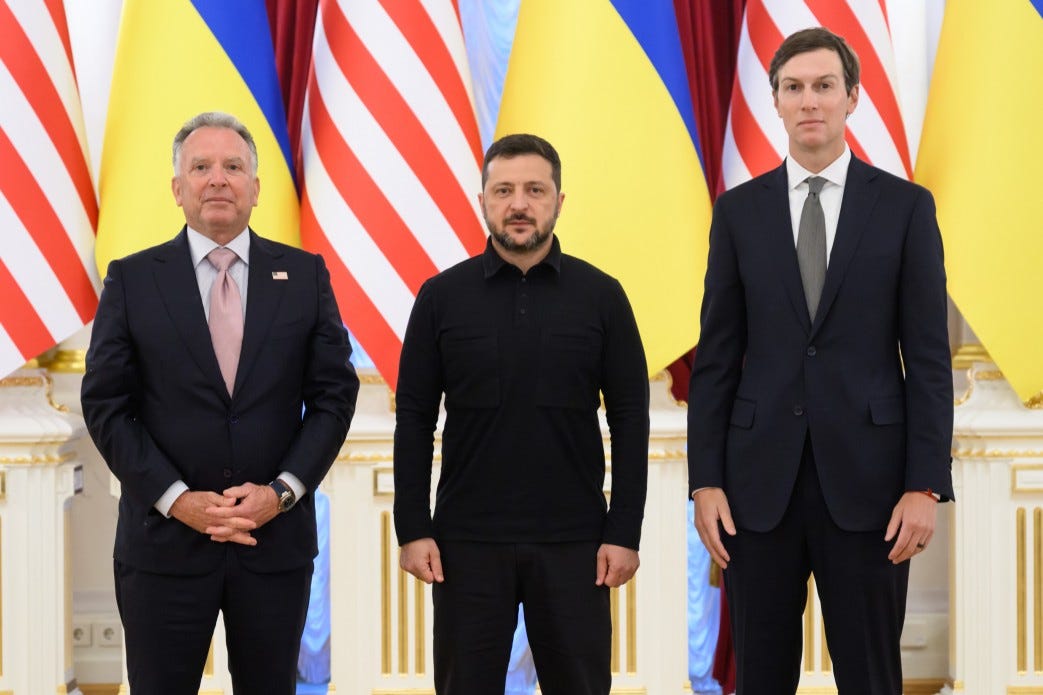
LAST WEEK, Steve Witkoff went to Moscow for the eighth time, where he raved to Vladimir Putin that his trips to the country imbued him with “incredible memories.” He gave the reigning war criminal a challenge coin that said “peace through strength,” a Trump administration motto that has so far ended no wars, but prolonged at least two.
From Moscow, Witkoff traveled to Kyiv—his first trip to the country, despite President Trump’s insistence that only his administration could end Russia’s war—where he compared the “Peace Express” train that he and Jared Kushner traveled on to the train he used to take when he traveled to see his grandmother in Florida.
Witkoff publicly treats one nation as a formidable equal and likens the other to a cute childhood memory. His public commentary reveals his opinions of the countries and their leaders; last year, he pushed a “peace plan” that would have had Kyiv cede its sovereign territory to Russia, promise to never join NATO, and reduce the size of its military, all in return for unnamed “security guarantees” from the United States. Tell us how you really feel, Steve.
I am feeling especially salty about Witkoff and Kushner’s apparent indifference to Ukraine’s suffering because this week happens to be the ten-year anniversary of the day I moved to Kyiv, sight unseen, hoping simply to learn and make a difference—two qualities that seem to be lacking in America’s chosen “peace” negotiators.
I was 27, and itching with the desire to do something that felt bigger than myself, bigger than my comfortable existence of writing program proposals and reports for the international non-profit where I worked, bigger than the newsletter I wrote for a few hundred colleagues. On a whim, I had applied for the Fulbright-Clinton Public Policy Fellowship, which sent folks in their 20s and 30s to be embedded advisors in allied government ministries. While there were slots around the world, from Peru to Kosovo to Samoa, I applied to go to Ukraine.
After five years of work supporting democratic movements that were—at best—struggling, it seemed that Ukraine had a real shot at breaking from the post-Soviet yoke. I was inspired by the commitment and bravery of Ukrainians during the Revolution of Dignity and frustrated by the U.S. Government’s indifference when Russia annexed Crimea and invaded the Donbas. In my application, I wrote about the necessity for the Ukrainian government to combat Russian propaganda and explain its policies clearly and transparently to its citizens and allies—a crusade that would become central to my career.
Before I even set foot in the country, I knew I wanted to help in any way I could. And I did. At the Foreign Ministry, I supported the spokesperson and press service team, doing everything from translating press releases to writing op-eds and wrangling international journalists. But the most important work I did wasn’t something I logged onto a computer to complete. The Fulbright program—conceived by Senator J. William Fulbright in the aftermath of World War II—was engineered to promote peace and build mutual understanding between the United States and nations around the world through exchange. Throughout my time in Ukraine, I grew close with my co-workers at the Ministry. They saw me through personal and professional hurdles. One of my colleagues got married during my fellowship; we all attended the wedding. (She still has a video of me giving a tipsy and extremely embarrassing toast in an ungrammatical mix of Ukrainian and Russian.) We all blubbered when my colleagues saw me off to the airport to fly home in 2017. Whenever I return to Ukraine or visit another country where one of them is posted, we spend time together as if it’s 2016 again.
It is these personal relationships—the core of the Fulbright program—that motivate my continued admiration for Ukraine. They gave me a deep understanding of the challenges my colleagues faced, their motivations for working in government, their aspirations for the country they wanted to build for their families. They want a country that is prosperous, peaceful, and free, just as Americans do.


But the Trump administration is not interested in understanding. It is interested in dominance and self-enrichment. If a program doesn’t directly help Trump and his cronies line their pockets, even if it is a comparatively small investment, it’s on the chopping block. Since returning to office in 2025, the Trump administration has attempted to all but eliminate international exchange programs, requesting an 80% reduction in the FY27 budget for Fulbright. (The House has pushed back and maintained the Fulbright allocation at its FY25 level—$288 million—but the budget has not yet passed the Senate.) The administration has also politicized the program, denying awards to people who didn’t pass its political litmus test and putting thousands of others through unprecedented review. (Fulbright awards are typically determined by an independent review board and insulated from political pressure.)
The same administration that wants to end one of its most effective investments in peace sent two men with extensive conflicts and troubling relationships to negotiate an end to a war on its behalf. In addition to “possible ideas for a settlement” of the “Ukrainian crisis” that Moscow created, the men discussed “major Russia-US projects that could be mutually beneficial to both sides,” according to Kremlin aide Yuri Ushakov. It’s no wonder Witkoff and Kushner remained fundamentally uncurious and uninterested in building the relationships and knowledge necessary to end Russia’s bloody and senseless war against Ukraine.
Ten years after I first arrived in Kyiv, I know that the mutual understanding Senator Fulbright sought to build in the aftermath of World War II is not based on the exchange of pleasantries or challenge coins. It’s slow work that can’t be done in a single parachute visit to a foreign capital, focused much more on the intangible motivations of people whose futures are being negotiated—why they fight, what they’ve lost, what they will not surrender—than on “mutually beneficial projects.” But Witkoff, Kushner, and Trump would rather create a windfall for a few than peace for millions. 🧭

Thanks for checking out The Wayfinder, where I help you navigate our polluted information environment. This is a space for people who believe a shared reality is the bedrock of democracy. It will always be free to access, because reputable information shouldn’t be behind a paywall.
If that resonates with you, join as a free subscriber to receive new posts in your inbox. Paid supporters help sustain this public work and receive the 10-Day Online Safety Tune-Up, access to the growing Wayfinder resource library, and invitations to occasional members’ conversations.
And if you can’t commit to a paid subscription, you can still support my work by buying me a coffee.
With gratitude,
Nina