

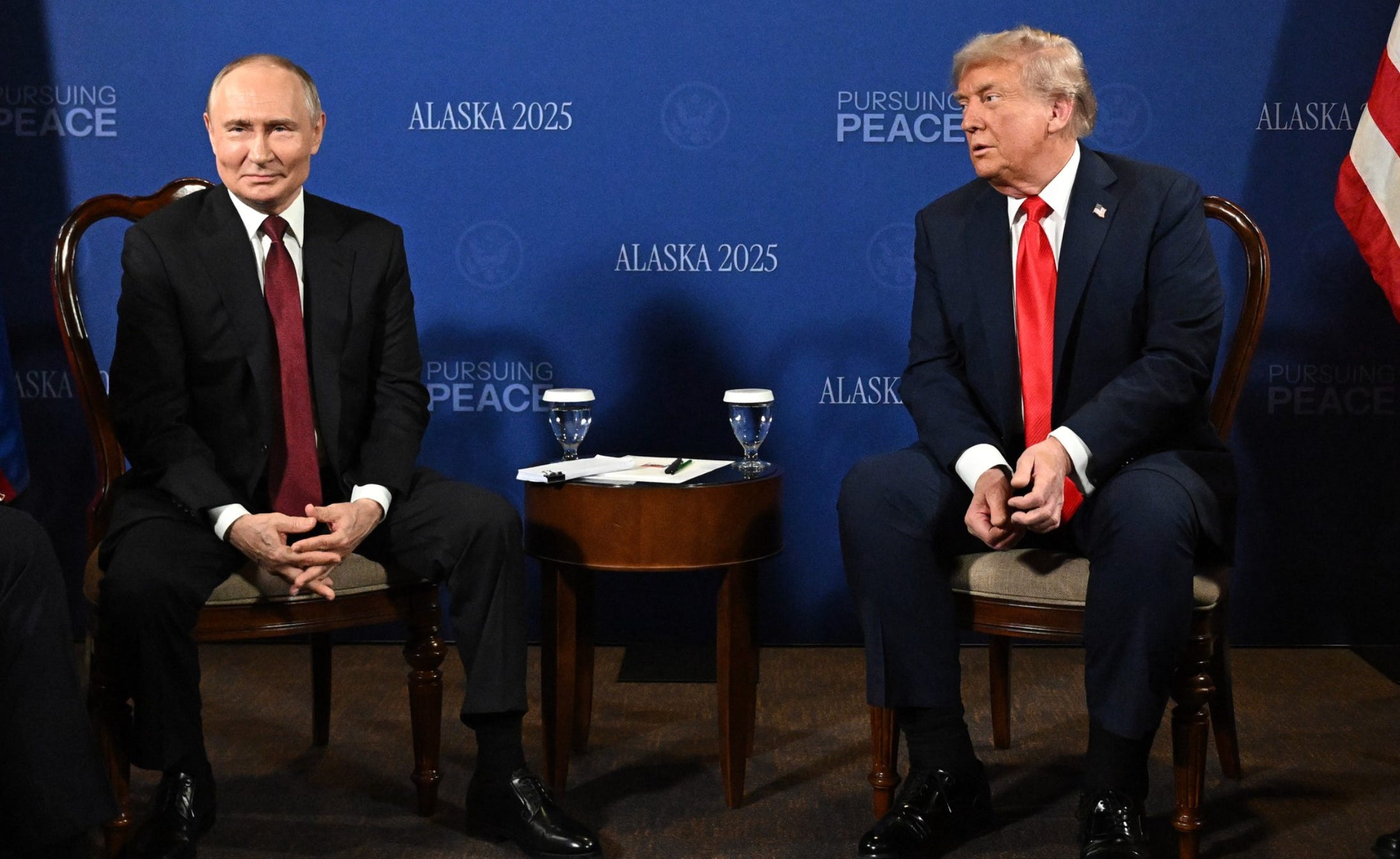
The last time Presidents Trump and Putin held a bilateral summit, I was on a cruise in Alaska. Onshore, I pointed out evidence of Russian influence to my husband—a shop advertising homemade Russian dumplings, a Russian Orthodox church—while on the ship, I was paying inordinate amounts of money for access to the internet so I could stay current on modern Russian influence in the leadup to the two leaders’ meeting in Helsinki, Finland.
I was able to use the shaky connection to do a couple of TV hits, including one with the Canadian Broadcasting Corporation. They cut away from my interview to air Putin and Trump’s now-infamous press conference, but kept me on the line, with my video on, in case they wanted my follow-up analysis. At one point—perhaps when Trump claimed he believed Putin’s insistence that Russia had not attempted to interfere in our election, then suggested that Washington and Moscow would jointly investigate Russian cyber intrusions—I apparently made a face of such disgust that the producer asked if I was okay.
Seven years later, I switched locations with the leaders. They met in Anchorage. I was in the Nordics (Norway, not Finland), as the summit took place. But other than the location, the outcome was the same: an embarrassing display from the American president, who believed everything the Russian leader told him; an undermining of our allies, who had gone to great lengths to ensure Trump understood the trap he was walking into; a propaganda coup for Russia; and no resolution for the challenge at hand.
I looked back at my writing on Trump and Russia from 2018, in the leadup to the Helsinki Summit. So little has changed. Then, I wrote:
“Nothing about us without us,” an organizing principle of democracies for centuries, has particular historical resonance in these lands, having famously been enshrined in a forward-looking Polish constitution covering much of modern-day Ukraine in 1505. Now, it seems to be abandoned.
As Putin and Trump joked like late night hosts on Friday’s red carpet, then shared a private drive in the Beast, no one with a working memory could miss the contrast between Putin’s treatment in Anchorage and the Oval Office ambush that awaited President Zelenskyy on his last trip to the United States. It’s clear that Trump, who has never visited Ukraine and has a Cold War high school textbook’s understanding of modern geopolitics, does not believe Ukraine or Zelenskyy to be worthy of a welcome of an ally. But Putin—whose economy is smaller than several U.S. states—is. His country is BIG. He doesn’t listen to the pesky Europeans. He plunders state resources and dispels political opposition with force that Trump envies. The U.S. President went as far as to tell Sean Hannity “We are No. 1 and they are No. 2 in the world.”
The substance of the meetings hasn’t changed much, either. In 2018, the leaders ostensibly discussed Russian election interference and its recent attempted poisoning of former double agent Sergei Skripal in the United Kingdom, but Ukraine—and its sovereignty—were on the menu even then, before the full-scale invasion:
Ukrainians are feeling a familiar sense of foreboding. Trump’s recent comments, reiterated at the NATO summit [...] suggest that caving to Russian ambitions in Ukraine—perhaps even formally accepting Russia’s illegal annexation of the country’s Crimean peninsula and aggression in the Donbas region—may be on the menu of concessions Trump is willing to make.
Though not announced at the Anchorage press conference, Christopher Miller and Amy MacKinnon at the Financial Times reported that Putin demanded Ukraine cede Donetsk and Luhansk to freeze the rest of the front line in Ukraine, a deal that Trump seems to be actively pursuing. He has abandoned the idea of a ceasefire; while he tries his hand at negotiations to end the war, Putin has license to continue terrorizing and killing Ukrainians.
For Putin, though, this isn’t just about borders and territory; it’s the continuation of a quest he’s been on throughout his rule to restore the Soviet Union’s bygone glory and respect. In his remarks, he claimed that “the situation in Ukraine is related to fundamental threats to [Russia’s] national security,” that is, NATO expansion and the westward trajectory of Ukraine and other former Soviet states Putin views as part of Russia’s sphere of influence. (If that wasn’t clear enough, his foreign minister wore a “USSR” when he landed in Alaska1.) The key to the end of the war, Putin said, was a “fair balance in the security sphere of both Europe and the world.”
It seems Trump will allow an autocrat and a war criminal—not America’s allies, not the victims of Putin’s aggression—to decide what “fair” means today.
After both Helsinki and Anchorage I remembered a phone call I overheard while living in Ukraine. The day after the 2016 election, I passed a Ukrainian grandmother chatting to a friend on her flip phone. “The U.S. has sold us out to the highest bidder,” she said.
U.S.-Russia relations have traveled a circuitous path since then. But as Trump prepares to meet Zelenskyy in the bedazzled Oval Office on Monday, he has not suddenly become a consummate diplomat. He remains the corrupt businessman he’s always been. He wants a deal, and for him, the values and norms that America has long counted as non-negotiables aren’t even on the balance sheet.
Curiously, Trump does not appear to have ridiculed him for his sartorial choices.