

Join me next Tuesday, October 6, at noon ET when I chat with Carmen Vicente of Scroll Sick—one of the best creators explaining the modern internet—about how we can stay sane online. Join us.
👀 Also... Watch this space! Next week I’m announcing a big new project right here on The Wayfinder. Ahead of the midterm elections, it’s one you won’t want to miss. 👀
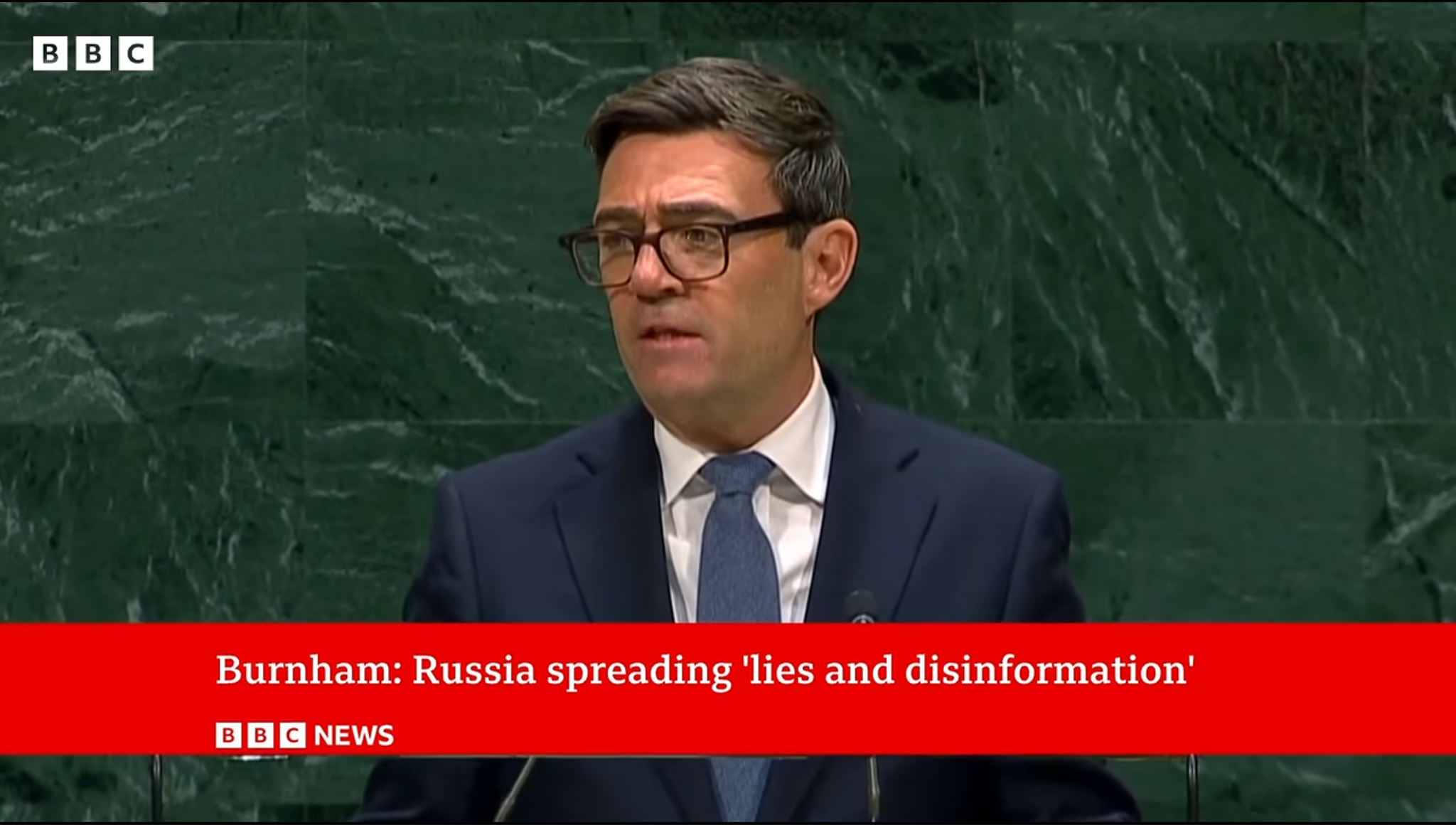
LAST WEDNESDAY, I was traveling in the UK when I woke up to texts from friends all sharing the same piece of news: overnight, UK Prime Minister Andy Burnham had used a few paragraphs in his speech at the UN General Assembly to announce the creation of a new National Centre for Information Defence.
The texts were pregnant with questions. They asked for my reactions, and more critically, my advice for the PM and his government as they undertook a challenge very similar to what DHS tried—and miserably failed—to do in 2022.
“In recent years we have seen an industrial-scale assault by hostile actors on the information environment in the UK and that of many of our allies,” Burnham told the General Assembly. “Russian agencies,” he said, “have used every means at their disposal to spread lies and disinformation and prey on people’s fears.” He listed a few of Russia’s tactics: using bots, fake websites, falsified newspaper articles, and forging the branding of British organizations to “amplif[y] far right narratives,” “interfere with the 2019 general elections,” and “stoke tensions and unrest in the wake of horrific events.”
That’s why, Burnham said, it was past time to “put in place the architecture we need to stem this poisonous tide.” The National Centre for Information Defence (NCID) will “detect, attribute and disrupt these kinds of hostile state information attacks.” The House of Commons recommended the creation of such a centre in an inquiry last fall.
Flying monkeys crying “censorship!” swarmed,1 despite a complete lack of evidence for the claim. Nigel Farage—who had appeared in the House of Representatives a year earlier to lambaste the EU’s Digital Services Act and the UK’s Online Safety Act as censorship—predictably railed against the new NCID as a “Ministry of Truth,” repeating the comparison the GOP had made between Orwell’s 1984 and the DHS Disinformation Governance Board. It’s not at all original, but who can blame them? That lie had successfully dismantled another government’s attempt to stem the tide of disinformation. Luckily, Larry the Cat, who has outlasted six Prime Ministers at No. 10 Downing Street, had a “cat check” at the ready:
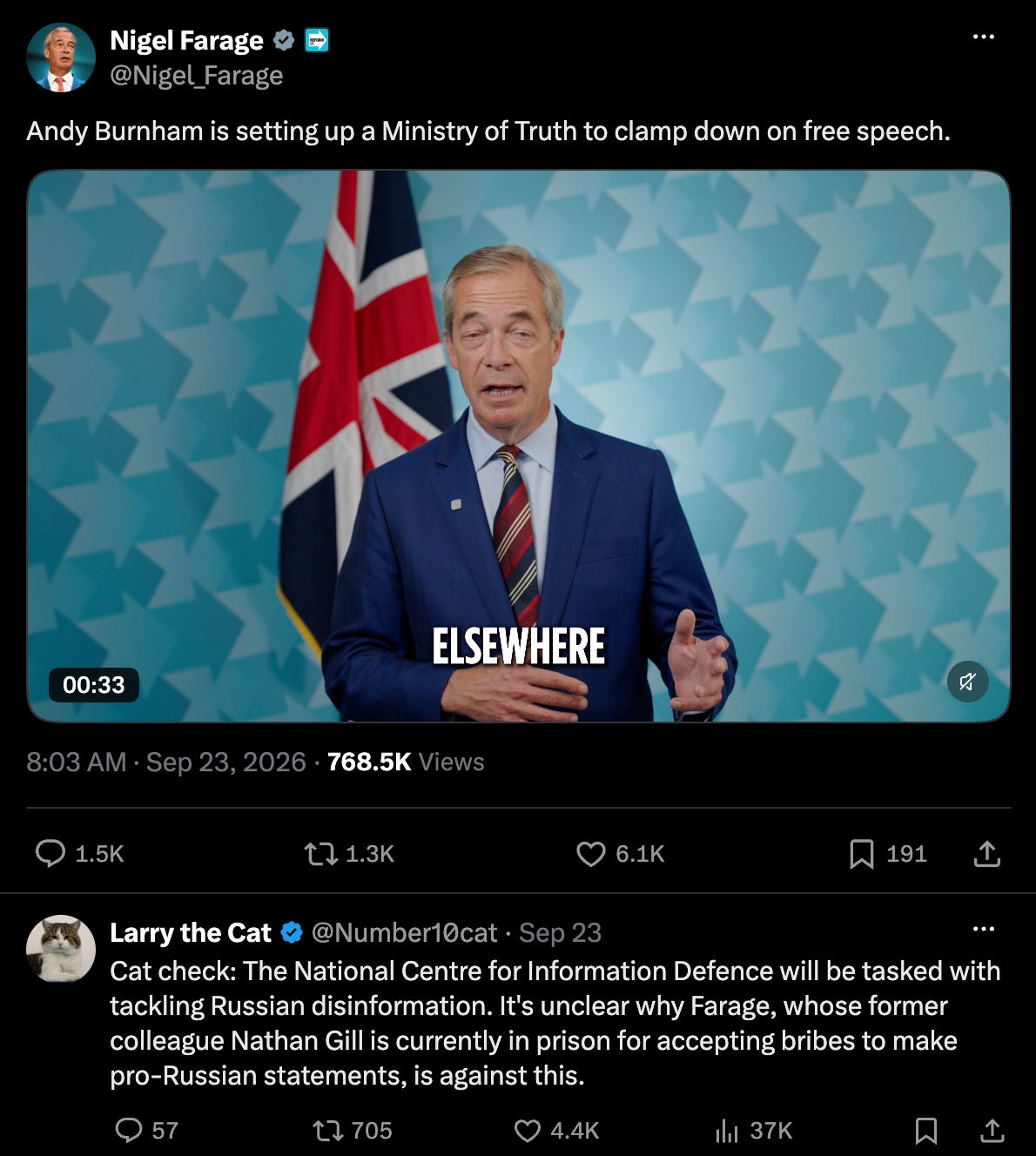
Let’s unpack the good, the bad, and the outlook for the UK’s new National Centre for Information Defence, in hopes that it doesn’t end up in the same watery grave as the Disinformation Governance Board and other U.S. Government efforts felled by politically motivated lies.
The Good
The Name. The National Centre for Information Defence is a comprehensible, democratically-minded name. Though you’ll have to pry the term “disinformation” from my cold, dead hands—I refuse to cede ground to folks who have deliberately poisoned the term—it was the correct move to focus on defense and the centre’s more proactive, national-security-focused stance.
The Focus. In addition to tying the NCID’s genesis to the Russian information threat, Burnham emphasized the importance of individual resilience—not takedowns or draconian censorship measures—as a key part of the antidote to hostile state disinformation:
We are going to help our people to strengthen their resilience – because faced with this information warfare, security starts in every home.
If you’re struggling with the cost of living and your life is not improving – or if you’re a young person not in employment, education or training – then you are going to be much more vulnerable to this kind of influence.
So part of the challenge is to lift our people up and create the opportunities they need.
When inequalities grow too wide, our societies are at greater risk.
So we will work to make life more affordable.
This is a throughline in my work as far back as 2017, and as I’ve written over and over (including in my first book), no nation will win the fight against falsehoods by playing whack-a-troll. Governments must invest in helping people navigate a complex internet that is quite literally preying on them every day, and it appears Burnham is prioritizing just that.

The Bad
The announcement. With sensitive issues like disinformation, a government is much better off over-explaining than creating an information vacuum. Burnham’s announcement could have included a more thorough explanation of what he hopes the NCID will do—coordinate responses among disparate government bodies, serve as a one-stop-shop for information about malign foreign campaigns, build resilience—and critically, what it will not do—like censor domestic speech. Instead, he left viewers to use their imaginations about what “detect, attribute, and disrupt” mean. Any time the government is involved with any aspect of the free flow of information, people will naturally imagine what those words might mean. If they’re predisposed to distrust the government or the party in power, it might be divorced from reality, but it’s incumbent on the speaker to try to bridge that trust gap.
Which brings me to the second unforced error in the content of Burnham’s speech: he focused on the amplification of traditionally right-wing narratives as an example of the type of interference that gave the NCID a reason for being. I don’t doubt that Russia has done this, nor do many cross-party Members of UK Parliament, but I think Burnham could have built a lot more trust with his audience had he focused instead on the ways disinformation can deprive citizens of their savings, their rights, and even their vote. Rather than making the Centre about lies affecting national security, an amorphous concept that normal folks have trouble identifying with, he could have connected it to their everyday lives.
The Outlook
Because the United Kingdom has not fully succumbed to the conspiratorial brain rot that plagues the US, I don’t think the NCID is doomed. While I was in London, I joined Channel 4’s The Fourcast, where I discussed the announcement with two cross-party MPs. As I said on the program, the fact that such a conversation could happen, with plenty of agreement between the MPs on the reasons for creating such a centre, is already miles beyond where the U.S. would be in a similar situation.
You can watch the rest of that conversation here. But the TL;DW is that it’s incumbent on the Burnham government to fill in the blanks with the public on what the National Centre for Information Defence will and won’t do. If it does, I think it could make important contributions to informing UK citizens and allies about continued foreign malign information campaigns, hopefully leading to a more informed and discerning public. 🧭
Thanks for checking out The Wayfinder, where I help you navigate our polluted information environment. This is a space for people who believe a shared reality is the bedrock of democracy. It will always be free to access, because reputable information shouldn’t be behind a paywall.
If that resonates with you, join as a free subscriber to receive new posts in your inbox. Paid supporters help sustain this public work and receive the 10-Day Online Safety Tune-Up, access to the growing Wayfinder resource library, and invitations to occasional members’ conversations.
And if you can’t commit to a paid subscription, you can still support my work by buying me a coffee.
With gratitude,
Nina
I wish I could claim credit for this image, but it was seared into my memory in 2022, when Charles P. Pierce wrote about my ordeal at DHS for Esquire. In addition to flying monkey comparisons, other memorable phrasing includes: “Democrats absolutely suck pond water at naming things” and “I hope that Nina Jankowicz sues the eyebrows off of all the people who slandered her, and that she wins enough fck-you money that she can go back into public service and not worry if she’s working for featherbeds who can blow away in a strong breeze.” I tried, Chuck!
Thank you for all that you do! I find the most concrete advice on how to counter disinformation from you.