

Welcome to The Wayfinder, your guide to our toxic information environment.
📺 Tonight, at 8pm ET, join me and Julie Roginsky right here for a live chat on Trump’s ongoing censorship crusade. Just open up your Substack app or navigate to thewayfinder.net at 8pm to join.
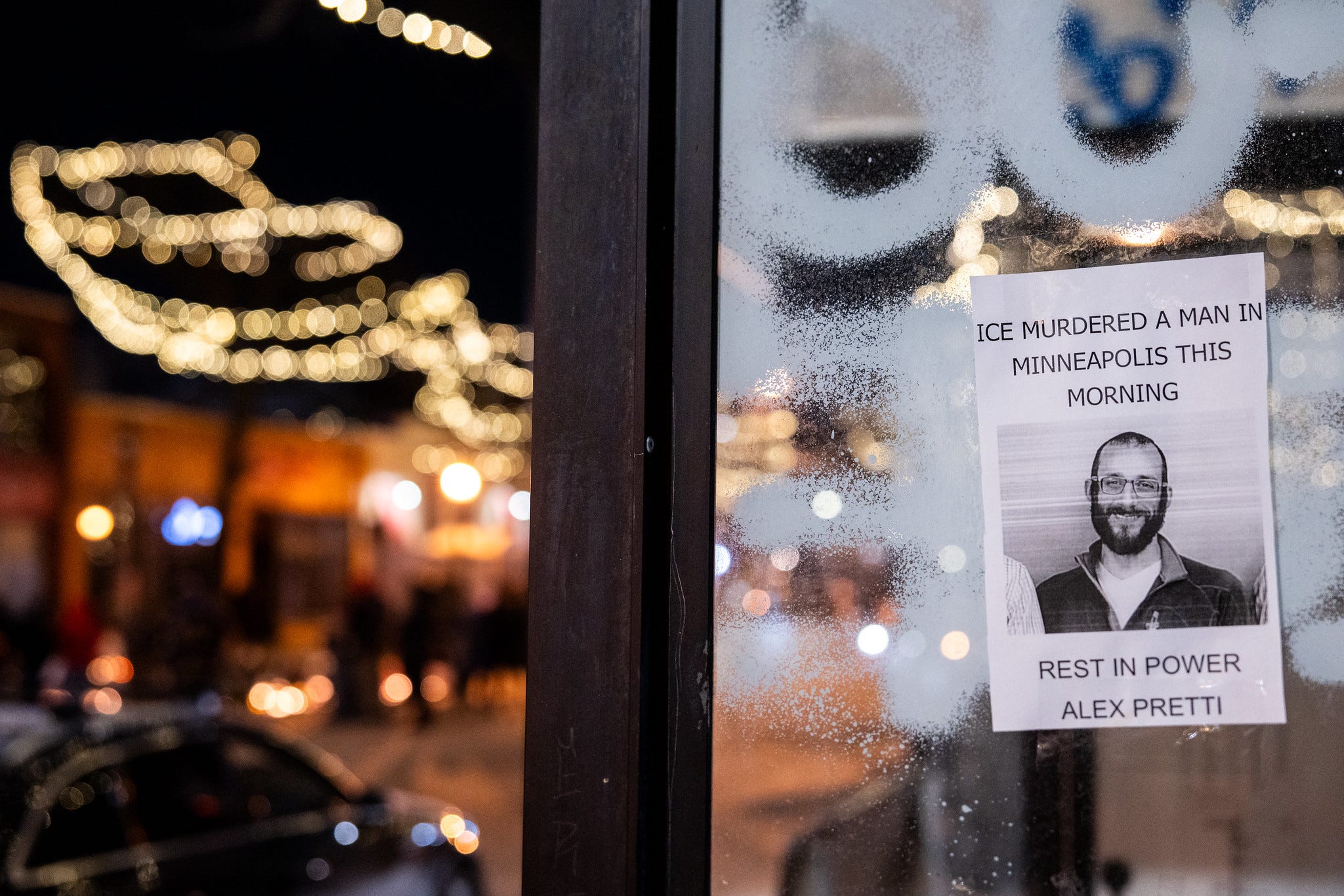
We watched another American die in an extrajudicial execution this weekend.
We read the witness affidavits, corroborating what we had already seen from multiple angles on the tiny screens in our hands: Alex Pretti was a helper, the proverbial “good guy with a gun.”
He was killed because he had the temerity to assist a woman who had been thrown to the ground by a power-hungry paramilitary member, because he confronted masked thugs about their inhumane behavior, because he dared to document it.
The Trump administration moved quickly to get in front of the video they knew would emerge from the scene, tweeting a picture of a handgun they had allegedly recovered from Pretti, claiming Pretti had wanted to “massacre” federal agents. Pretti was carrying a permitted, open-carry gun—one that agents disarmed him of before they repeatedly shot him.
We know this because the people of Minnesota have been bravely documenting ICE and CBP’s actions in their state, and because a community of open-source investigators quickly analyzed their footage to prove the administration was lying.

The visual evidence of the murders of Alex Pretti and Renee Good—as well as other videos and photos of the Trump administration’s lawlessness as it assaults blue states—has reminded me of Ukraine, where since 2013, the increasing prevalence of mobile phones and high-speed internet connections has resulted in social media content documenting Russia’s crimes, allowing open-source analysts to hold the Kremlin to account.
Since then, general awareness of open-source intelligence—“the process of gathering and analyzing publicly available information to assess threats, make decisions or answer specific questions,” also known as OSINT—has grown. This sometimes puts more eyes on a particular problem, which can mean more accountability. But there are also folks claiming to be open-source investigators who are either (1) well-intentioned but inexperienced, drawing conclusions unsubstantiated by evidence or (2) malicious, using the veil of OSINT to deliberately spread a false narrative.
To sort these motivations out, I asked for help from two of the best in the business: Eliot Higgins, the founder of Bellingcat, an independent investigative collective of researchers, investigators and citizen journalists using OSINT for good, and Lou Osborn, the co-founder of INPACT, a group of investigators known for their work exposing the crimes of Russia’s Wagner group. Their advice has been lightly edited for length and clarity.

Trustworthy Investigators Show Their Work
Eliot: Good investigators walk you through where the information came from, what steps they took, what bits they’re unsure about, and what they simply couldn’t verify. It’s a red flag when anyone just declares “this is what happened” without explaining how.
Lou: You should be able to reproduce the investigation yourself. Good investigators lay down all of what they have, what is the reasoning and what do they follow to come to the results. There is no “insider source” or “special source.”
Trustworthy Investigators Welcome Discussion
Eliot: They’re transparent about sources; if they’re using open source evidence and they’re not sharing the sources, or are unwilling to do so when asked, then they’re more interested in farming engagement than collaboratively finding the truth.
They also correct themselves when they’re wrong. When genuinely trying to get to the truth, people will update their assessment or even retract things when better evidence shows up. Accounts that are mainly chasing clicks and engagement tend to just dig in harder and deflect instead. Also look at the account’s past behavior. If it’s all about getting engagement then you know you shouldn’t rely on their claims.
Lou: They are open to discussion and are happy to re-demonstrate how they do their work. This may seem basic but it can be a giveaway that an investigator isn’t trustworthy.
Trustworthy Investigators Don’t Overstate Their Case
Eliot: Serious work tends to be careful and measured, with lots of caveats. When someone makes very confident, black-and-white statements based on partial video or a few photos, you should be skeptical.
Anyone who’s relying on a single video or image to make grand claims is usually unreliable. An individual image or video on its own almost never tells the full story, especially about motive or broader context. The strongest investigations combine the footage with other things: timestamps, geolocation, witness accounts, documents, known facts about weapons/vehicles/uniforms, etc.
There’s Reason for Hope
Open source investigators from Bellingcat provided crucial material to the international Joint Investigative Team that prosecuted the case against those who shot down MH17 with a Russian missile, killing hundreds of civilians. Open source evidence helped establish culpability for the Kremlin’s war crimes in Bucha. It has proven, beyond even a shadow of a doubt, that Russia is responsible for bombing playgrounds, children’s hospitals, maternity wards. It has tracked down children Russia kidnapped from Ukraine and returned them to their homes. While Putin’s Russia has yet to face full accountability for its crimes, open source material will help in prosecuting that case for years to come.
The same can happen in the United States. Everything feels bleak right now, but I have hope that thanks to the bravery of those putting their bodies on the line to document the Trump administration’s depravity—along with the ingenuity of people like Eliot, Lou, and their colleagues—the arc of history will bend toward justice for Renee Good, Alex Pretti, and all those whose lives have been unjustly upended by Trump and his thugs. 🧭
Have a personal question about disinformation, online safety, or digital harms? Submit it to my advice column here!