

Your feedback matters to me! Please take this short survey to let me know how you’ve enjoyed The Wayfinder over the past six months. 🧭
THINK BACK TO SUMMER 2024, to the lime green, meme-laden, hopium-laced “brat summer” before Donald Trump was elected to the presidency a second time. The presidential election was described as the first “influencer election,” when both parties were embracing the power of content creators to inform voters and drive behavior change. The Democrats boosted the clip economy and credentialed over 200 influencers to attend the DNC, among other strategies. But their play looked timid in comparison to the GOP’s long-term gambit, which involved a well-oiled, targeted, free-flowing creation and amplification machine that indexed on longform content.
There’s been a lot of ink spilled on where the Dems went wrong in 2024, as well as the party’s continued struggles building a content machine to rival the GOP’s today. I’m not invoking the ghost of brat summer to discuss which party is better at internetting—the answer is obvious. Instead, I’m thinking about 2024 and its aftermath because it demonstrated the troubling gulf between the mainstream, credentialed press and creators in stark relief.
Take the 2024 DNC, where the Party’s wining and dining of content creators left the mainstream press (rightly) pissed off with their comparatively shabby treatment. Or the ways since then that the mainstream media have irked creators, sometimes engaging in behavior and coverage that comes off as belittling, whether publicly or privately, intentionally or not.
Though it’s often cast in the context of political power—which strategy for engaging the media, both mainstream and new, delivers election victories—this trend of animosity within the sector (because press and creators are a single sector, whether they like it or not) is bigger than that. It’s creating a zero-sum incentive structure that has already led to a degradation of the information infrastructure that is leaving people less informed, and it’s time for everyone to put on their big kid pants in service of the greater good.
A Non-Exhaustive List of Beefs
Attribution
In Twitter’s heyday, when I would publish a new piece, I relished seeing how it was getting shared across the platform. All sorts of folks would distribute and amplify my work: journalists, average users, celebrities. Sometimes I would get tagged, sometimes I wouldn’t. I didn’t care; it wasn’t the reference section to an academic paper. I was just happy to see people learning from my writing.
I think about this when I hear gripes from journalist friends who say that creators are “stealing” their stories, angry that creators are “reporting” news to their audiences they didn’t actually report. I don’t see it that way at all. While there are less-than-scrupulous creators who don’t give credit where it’s due, videos with picture-in-picture or greenscreen screengrabs of the article being referenced are popular and highly-engaged with; often such videos will be a user’s first contact with a particular story.
Similarly, news organizations complain about the lack of editorial standards they see in creator-driven vertical video; as I’ve written before, platform algorithms, which incentivize emotional content, drive some to post sensationalist or conspiratorial videos so they can make rent.

The topline is this: Creators add context and their own interpretation of the news, which helps them connect with their audiences. When creators explain and react to journalistic content, is it “stealing,” or is it sharing? I’d argue it’s the latter—the modern form of a Twitter tag. And if journalists are worried about the lack of referral traffic from these videos or the way the content might be sensationalized, their gripe isn’t with the creators, it’s with social media platforms that disincentivize users clicking links, closing apps and moving off-platform, and reward them for posting rage bait.
Competition
Downstream from attribution is legacy outlets’ and journalists’ concerns that content creators are their competition. This concern is embodied by framing of Reuters’ coverage about the journalist-creator dynamic at the 2024 DNC:
Influencers have access to a creator lounge in the United Center and a creator platform section on the convention floor where they can create video content.
The besieged journalism industry, which has lost tens of thousands of jobs from cost-cutting and consolidation over more than a decade, had its space at the convention slashed compared to previous conventions, according to another Pew study.
“These are the worst working conditions of the 20 conventions I have covered,” said Jonathan D. Salant, assistant managing editor of politics at the Pittsburgh Post-Gazette.
In its 2026 survey of 280 digital media leaders from 51 countries and territories, the Reuters Institute for the Study of Journalism at the University of Oxford found that 70 percent of those surveyed were worried about creators “taking time and attention away” from their work, while only 39 percent were worried about losing talent, in a year when many formerly mainstream reporters made the leap to the land of online creators:
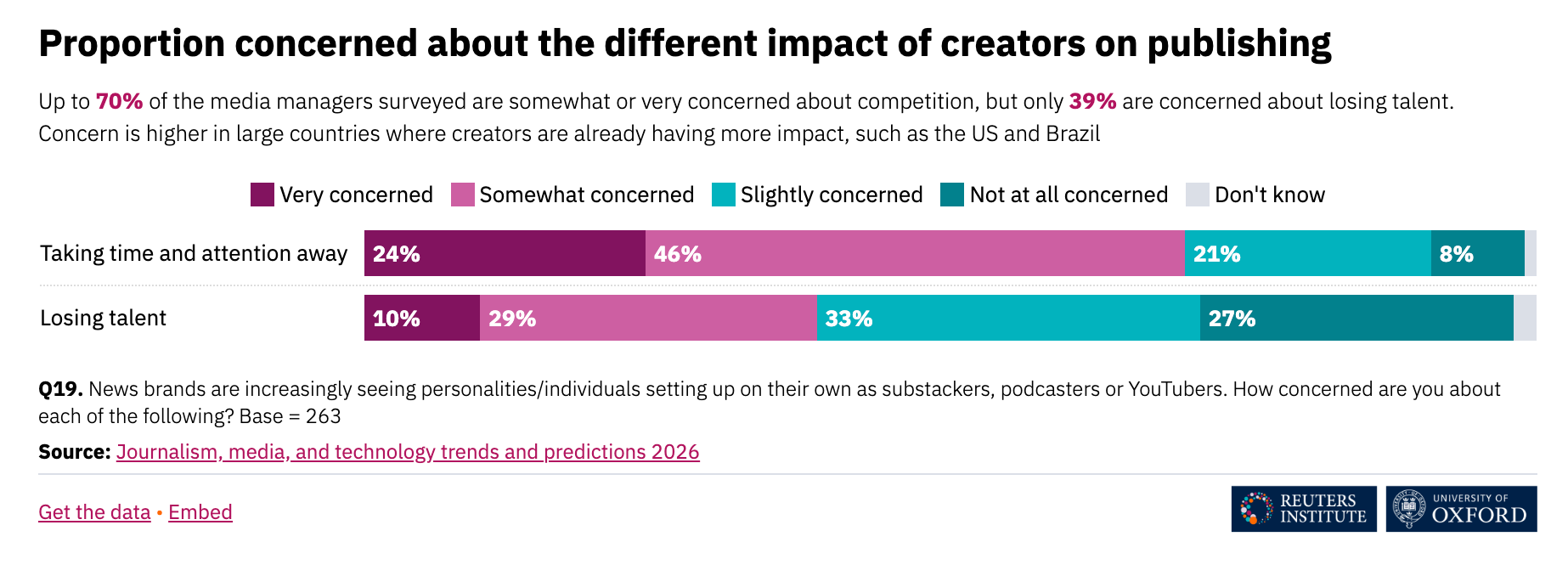
But, according to RISJ’s Digital News Report, which surveys news consumers in 48 global markets, 77 percent of people surveyed consume news online each week, and “most people who get news from creators are using them alongside traditional media – not instead of it. In fact, those who access creators consume more traditional media than the average respondent.”
Trivialization
Creators, for their part, have plenty of complaints about the mainstream media, but by far the one I see echoed the most frequently in their videos is that the press trivializes both the work creators do and its impact. Content creation is treated as a “side hustle” or inherently unserious because it grew on platforms that got their start as a home for viral dance trends. But the platforms aren’t just for silly videos anymore—creators drive behavior change, movements, impact, and even reporting. And, as RISJ’s report shows, audiences find creators easier to understand and more entertaining than traditional media:
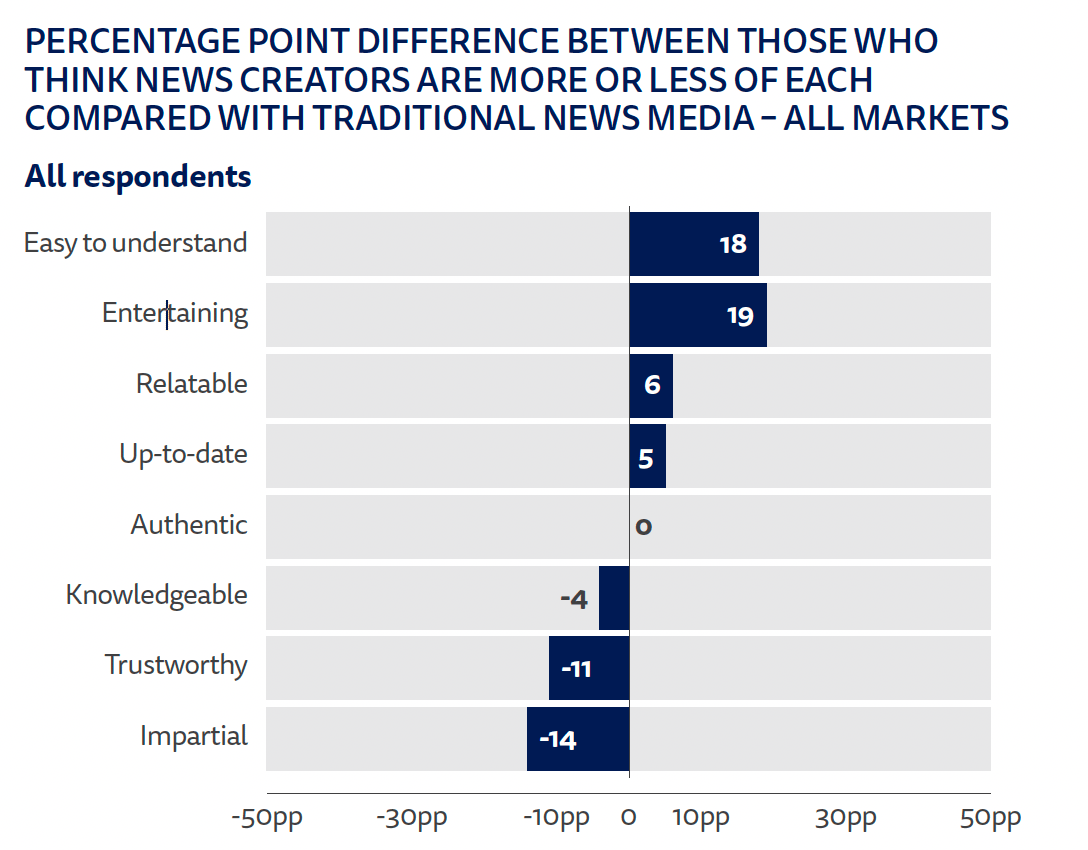
I can feel hundreds of pairs of journalists’ eyes rolling—who cares if creators are entertaining?! The news isn’t meant to be entertaining! Sure, we all might like to believe that. But for the past ten years, everyone from Kremlin trolls to MAGA shitposters have been making a bet on infotainment while the rest of us clutch our pearls. We need to work with the information environment that we have, not the one we’d like.
Burying the Hatchet
Earlier this year, serious allegations of sexual abuse tanked Senator Eric Swalwell’s California gubernatorial campaign. Creators Arielle Fodor (“Mrs. Frazzled”) and Cheyenne Hunt first surfaced the accusations; they were then reported out by CNN. As Susie Banikarim of the Columbia Journalism Review writes:
What made the creators’ approach notable wasn’t just their persistence. It was their understanding that social media influence alone would not be enough to take on a powerful politician and care for Swalwell’s accusers. They coordinated with the women who confided in them, helping them find legal counsel and directing them to CNN once they were ready to share their stories.
This example shows that collaboration between the warring camps is possible and productive, and that it can have positive, seismic impacts for democracy.

If I were advising mainstream media about how to compete in this environment, I’d tell them it’s time to bury the hatchet, stop publicly griping about each other1 and start collaborating with content creators and replicating what they do. (The same goes for experts, which I discussed in my recent keynote at GlobalFact.)
Collaboration
For collaboration between legacy media and creators to work—that is, for such work to feel authentic to creators’ audiences—it has to be more than a quid pro quo, “we report the news, you make videos about it and receive payment in return.” This might look like:
Reporting a story based on creator tips—like CNN did with the Eric Swalwell story—and involving creators in the process.
Inviting creators to shadow journalists for a period of time and make content about the process, pulling back the curtain on the parts of the reporting process that are rarely seen by the public.
Hiring creators to skillshare with your newsroom about scripting, shooting, and building and maintaining audience trust.
The uniting factor here is not to treat creators as a sideshow, but as experts in audience cultivation and retention. Recognize what they do is work. Come to them with humility and a desire not to learn from them, not just to extract value from them.
Creators need humility, too. I often see creators telling audiences that “no mainstream media are reporting” whatever their topic is, and nine times out of ten, that’s just not true. Goodwill needs to go both ways.
Empowering Journalists to Make Vertical Video
Remember when posting to Twitter was seen as a necessity for journalists? (For some, it still is—yikes!) Why were journalists never empowered to take the same leap into vertical video? Sophia Smith Galer—who cut her teeth at the BBC and VICE, makes beautiful video explainers for her 1+ million followers, and trains others in how to replicate her success—points out that more newsrooms are prioritizing making vertical video with high production values, but these videos
aren’t coupled with lower production value, faster-to-make videos that are platform native coming from individuals. Content remains glued to publisher accounts across the board and journalists uploading work themselves (like they’ve done on Twitter for years) remains the exception, not the rule.
To me, the gap is structural:
Journalists need to know that their newsrooms want them to make this authentic content about their reporting and the behind-the-scenes of it, and they need to know it won’t get them in trouble; this means creating or updating a social media guidebook with basic standards for journalist-generated vertical video.
Journalists also need the space and support to make this content. Even when you’re making quick, off-the-cuff videos, it takes time, and journalists shouldn’t be forced to make content in their time off. This should be factored into the workload that newsrooms envision for their journalists, understanding that they might not be filing ten stories a week if they’re also making video, but are doing integral work rebuilding trust with audiences and even reaching new ones.
What’s at Stake
Since 2024, I have been in more conversations than I care to admit in left-of-center circles in which the privileged few—journalists and executives from mainstream media, national security professionals, experts, political consultants—give creators short shrift. We all need to wake up. As much as I’d like to go back to the information environment of the 2010s—ah, those halcyon days!—it’s not going to happen. As Jermaine Fowler wrote in a great essay this week, social media is media now.
My friend Sabra Ayres, who spent 20 years in traditional newsrooms around the world and now trains local journalists in Ukraine—including a course this year for local media on making mobile-first vertical videos—says she’s telling her grantees that “they better get used to creators and try to work with them instead of against them.” I agree. We can each keep trying to push our own boulders of truth uphill amid an avalanche of lies, or we can roll downhill, push the boulder into a lake, and make powerful ripples together. 🧭
I keep this writing free because access to careful analysis shouldn’t be paywalled, especially when the information landscape is this fragmented.
If you find it useful and want more of it, you can support it with a subscription for just $5 a month or $50 a year.
If you can’t, sharing the work helps it do what it’s meant to do.

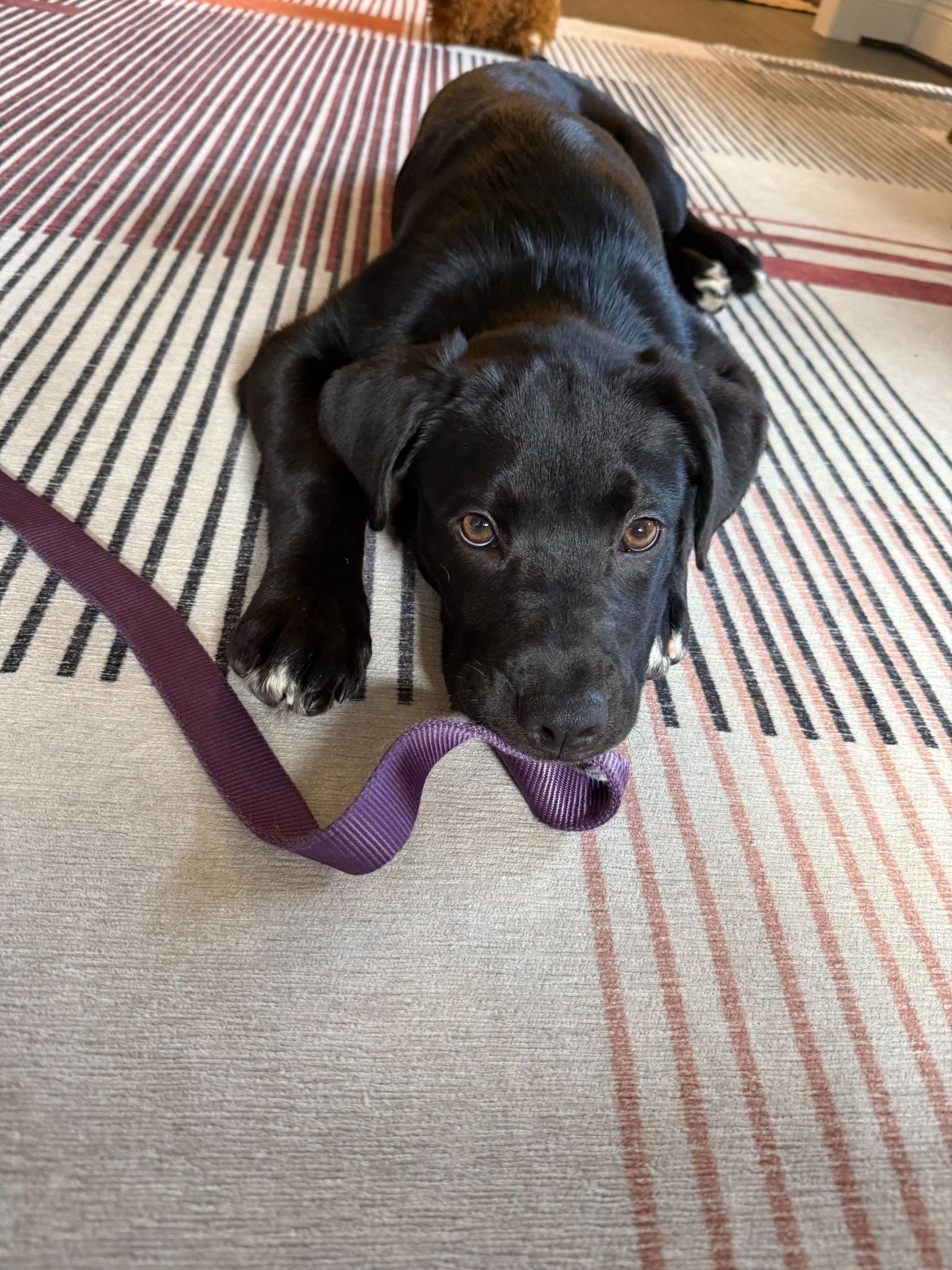
Thanks for bearing with me this week! We just got a new puppy—meet Kaylee!—so it’s honestly a miracle I wrote anything at all. I won’t be sending out any field notes this week, but hope to be back to a two-post-per-week schedule when we’re more settled in.
You don’t see right wing media and creators doing this very frequently! On the right, creators and media have a sickly symbiosis that generates narrative heft for their side. For years, the largest right-wing media platforms have regularly hosted and lent full credibility to the craziest creators of the moment. Now, some of the former “mainstream” media personalities like Tucker Carlson and Megyn Kelly have gone full-blown “creator.” I could write an entire piece on this, but for now, suffice it to say that we don’t need full-on fascist narrative discipline—we should just settle our misgivings in private.